
How to Pick a Winning Horse Using Racecard Data
Best Horse Racing Betting Sites – Bet on Horse Racing in 2026
Loading...
Favourites win roughly 30 to 35 percent of all UK races, which means two-thirds of the time the market’s top pick loses. That statistic is both the problem and the opportunity for anyone trying to figure out how to pick a winning horse. The market is right more often than any individual punter, but it is wrong frequently enough to make systematic analysis worthwhile — and the racecard is where that analysis starts.
Picking winners is not fortune-telling. It is pattern recognition applied to structured data, and the racecard provides every input the process requires: recent form, going conditions, race class, draw position, trainer and jockey records, official ratings, and equipment changes. The punter who works through these inputs systematically — filtering the field rather than guessing at it — will not pick every winner, but will pick them at a rate that justifies the effort.
This guide presents a five-filter framework for selecting horses using the racecard, applies it to a worked example, and identifies the mistakes that the framework is designed to prevent.
The Five-Filter Framework — Form, Going, Class, Draw, Connections
Rather than weighing every data point on the racecard equally, the five-filter framework prioritises the factors that most consistently predict race outcomes. Apply them in order, and the field narrows with each step.
Filter 1 — Form. Start with the form line. Scan each runner’s last three to five results and eliminate any horse that has not shown competitive form recently. “Competitive” does not mean “won” — a second or third behind quality opposition on suitable ground qualifies. But a string of zeros and non-completions in the recent form line is a clear signal that the horse is either out of form, misplaced or declining. Remove those runners from consideration. The form filter typically eliminates a third of the field in a competitive handicap.
Filter 2 — Going. Check the official going for today’s race, then cross-reference each surviving runner’s record on that ground. A horse with no experience on today’s going is an unknown quantity; a horse with a poor record on similar conditions is a known risk. Filter by going eliminates runners who may have good form in the abstract but produced that form on a different surface. Going preferences are among the most stable characteristics a horse possesses — they rarely change, which makes this filter reliable over time.
Filter 3 — Class. Assess whether each runner is competing at its level, stepping up or dropping down. In handicaps, where favourites win approximately 26 to 27 percent of the time compared to 39 percent in non-handicaps, class evaluation becomes particularly important because the handicap system is designed to equalise the field. A horse stepping up in class needs to be improving to compete; a horse dropping down may have an advantage the official rating does not fully capture. Filter by class removes runners that are clearly outclassed by the rest of the field.
Filter 4 — Draw. At courses with known draw bias — Chester, Beverley, Musselburgh, Ascot’s straight course — check the stall position for each surviving runner. A horse with strong form, suitable going and the right class level but a poor draw faces a structural disadvantage that no amount of ability can overcome at certain tracks. At courses with no significant draw bias (most galloping and turning tracks), skip this filter. The racecard’s draw column tells you the stall number; your knowledge of the course tells you whether it matters.
Filter 5 — Connections. Check the trainer’s recent form (last 14 days) and the jockey booking. A horse that passes the first four filters and is trained by a yard in strong current form, ridden by a jockey with a high strike rate at this course, has the connections profile that supports the selection. A horse that passes the first four filters but is trained by a yard in poor form or ridden by an inexperienced replacement jockey has a question mark that the card data cannot resolve.
After five filters, the field is typically reduced to two or three runners. The final selection among them comes down to price — which of the remaining horses offers the best odds relative to its chance? The racecard provides the data for every filter; the odds column provides the pricing for the final decision.
Applying the Framework — Worked Example
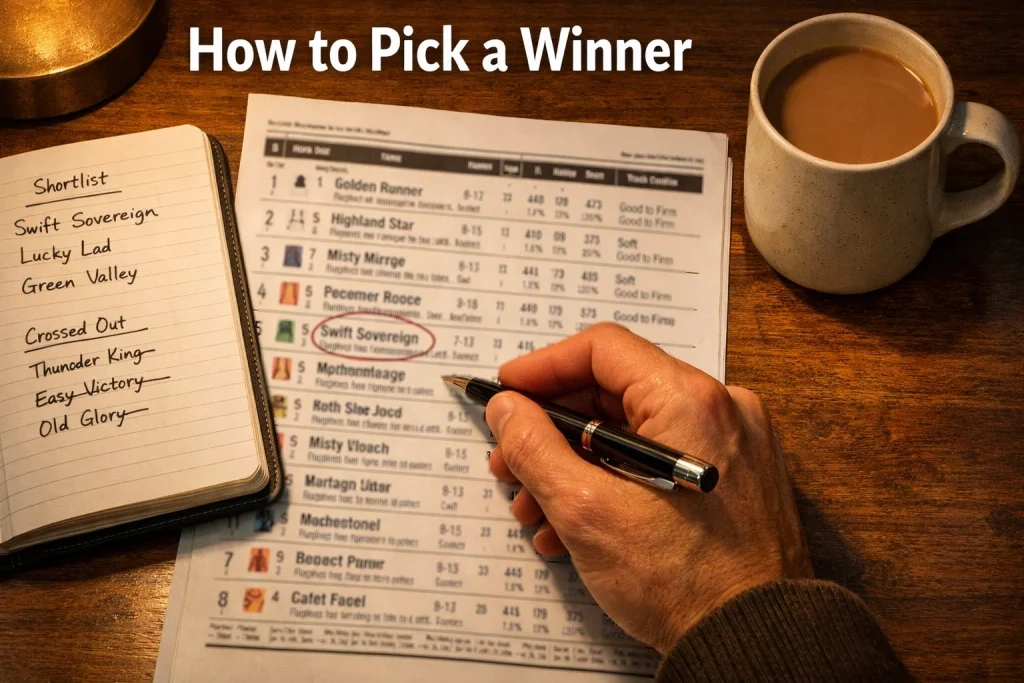
A Class 3 handicap over a mile at Haydock on Good to Soft ground, 12 runners. Apply the five filters in order.
Form filter: Runners 3, 7 and 11 have form lines containing multiple zeros and a pulled-up in their last four runs. Eliminate them. Nine remain.
Going filter: Of the nine, runners 1 and 9 have never raced on softer than Good. Their going records show no evidence of handling today’s conditions. Eliminate them. Seven remain.
Class filter: Runner 5 is stepping up two classes from a Class 5 win and has no form at this level. The official rating is 12 pounds below the field average. Eliminate. Runner 12 is dropping from Class 2 and has an RPR significantly above the field. Keep. Six remain.
Draw filter: Haydock’s mile start has no significant draw bias on Good to Soft ground. All six pass. Six remain.
Connections filter: Runner 4’s trainer has not saddled a winner in 30 days and has a 4 percent strike rate over that period. The jockey is a late replacement for the originally booked rider. A question mark, but not disqualifying. Runners 6 and 12 are trained by yards with 18 percent and 22 percent recent strike rates respectively, and both have their first-choice jockeys booked. These connections profiles are the strongest in the field.
The framework produces a shortlist of two: runners 6 and 12. Runner 12 is the dropper in class with the highest RPR, priced at 4/1. Runner 6 has strong recent form on today’s going, a proven course record (C and D flags visible) and is priced at 7/1. The card data favours Runner 6 on course form and going; it favours Runner 12 on class and rating. At 7/1 versus 4/1, Runner 6 offers a better price for a comparable chance. The framework selects Runner 6 — not with certainty, but with a structured rationale that the racecard supports.
Common Mistakes — What the Card Warns You Against
The framework exists partly to prevent the errors that even experienced punters make when picking horses without a system.
Over-relying on one factor. A horse that won last time out is tempting, but if the going has changed, the class is higher and the draw is unfavourable, the recent win is the least relevant piece of data on the card. The five-filter framework forces you to assess multiple dimensions rather than anchoring on the most visible one.
Ignoring going changes. The going on race morning may differ from the going when you studied the card the night before. A horse that passed all five filters on Good to Soft may fail the going filter if the ground deteriorates to Soft overnight. Always recheck the going before the first race. The card updates in real time on digital platforms, and a going change can invalidate an entire morning’s analysis.
Chasing recent winners. A horse that won its last two races is attractive, but the market knows this too — and the price will reflect the winning run. The question is not “has this horse been winning?” but “is this horse still good value given that everyone knows it has been winning?” The racecard shows the form; the odds column shows whether the form is already priced in. Both columns need to be read together.
Neglecting the price. The best selection in the field at 4/6 is a poor bet if the probability of winning does not justify the outlay. The framework identifies the strongest candidates; the odds determine whether backing them is worthwhile. Filter by the card, then decide by the price. That sequence — analysis first, value second — is the discipline the racecard rewards.