
Horse Welfare in British Racing: Safety Data and Industry Standards
Best Horse Racing Betting Sites – Bet on Horse Racing in 2026
Loading...
Horse welfare in UK horse racing is the obligation that sits behind every racecard. Before runners appear on the card, they must pass veterinary checks, meet fitness standards and race under a regulatory framework designed to minimise risk. The welfare infrastructure is largely invisible to the racecard reader — no column on the card displays veterinary clearance status or safety ratings — but it determines which horses are allowed to run, under what conditions, and with what protections in place.
The subject carries weight. Racing involves inherent physical risk to the horse, and the sport’s legitimacy depends on demonstrating that it manages that risk responsibly. The data available from the BHA, the Horse Welfare Board and independent researchers provides a measurable account of how British racing has performed on welfare over time. The trend is positive, but the numbers — fatality rates, veterinary investment, regulatory intervention — deserve examination rather than assumption.
This guide covers the safety data, the investment in veterinary research and what welfare measures mean for the punter reading a racecard.
Fatality Rates and Safety Trends
The most widely cited welfare metric in British racing is the fatality rate — the number of horses that suffer fatal injuries per number of starts. In 2023, the BHA recorded 158 fatalities from 87,619 starts, producing a fatality rate of 0.18 percent. That figure represents a decline from 0.20 percent in 2022 and continues a longer-term downward trend that has seen the rate fall from approximately 0.30 percent in the early 2000s.
The improvement is not accidental. It reflects a series of deliberate interventions: modifications to racecourse fences (particularly at Aintree, where the Grand National fences have been reshaped), improved veterinary oversight at courses, tighter regulations on ground conditions and watering, restrictions on the age and fitness of horses allowed to compete, and investment in pre-race screening. Each of these measures operates upstream of the racecard — they affect which horses appear on the card and under what conditions, even though the card itself does not display the welfare infrastructure.
Professor Tim Parkin of the University of Bristol, one of the leading researchers in equine epidemiology, has described the sustained improvement in fatality figures as remarkable and a credit to all involved in the industry. That assessment is supported by the data: the rate of fatal injury has decreased consistently across both Flat and National Hunt racing, with the most significant reductions in jump racing, where the inherent risk is highest.
The distinction between Flat and jump fatality rates is important for context. Jump racing produces a higher fatality rate than Flat racing because the obstacles add a physical variable — falls, heavy landings, fence-related injuries — that does not exist on the level. The BHA’s welfare strategy has focused disproportionately on jump racing as a result, with fence modifications, going management and jockey education all targeted at reducing risk over obstacles. The racecard for a jump meeting operates within this framework: the going description, the race conditions and the non-runner declarations are all, in part, products of welfare-informed decisions.
The data shows improvement, and the trajectory is clearly positive. But the numbers also confirm that risk cannot be eliminated entirely — 0.18 percent is not zero, and 158 fatalities represent 158 individual animals. The sport’s approach is to reduce the rate through evidence-based intervention while acknowledging that horse racing, like any athletic pursuit involving animals at speed, carries an inherent risk that can be managed but not removed.
Veterinary Investment and Research
British racing has invested more than £60 million since 2000 in veterinary science and education, making it one of the largest funders of equine health research of any sporting body in the world. That investment is channelled through the BHA’s Horse Welfare Board, which coordinates research programmes, sets welfare policy and publishes findings that feed directly into regulatory changes.
The research covers a broad range of areas: musculoskeletal injury prevention, the biomechanics of jumping, the relationship between training methods and injury risk, post-race recovery protocols, and the long-term health of retired racehorses. Several major studies have been published in peer-reviewed journals, including the Equine Veterinary Journal, and their findings have influenced practical policy — the modifications to Aintree’s fences, for example, were informed by biomechanical research on landing forces.
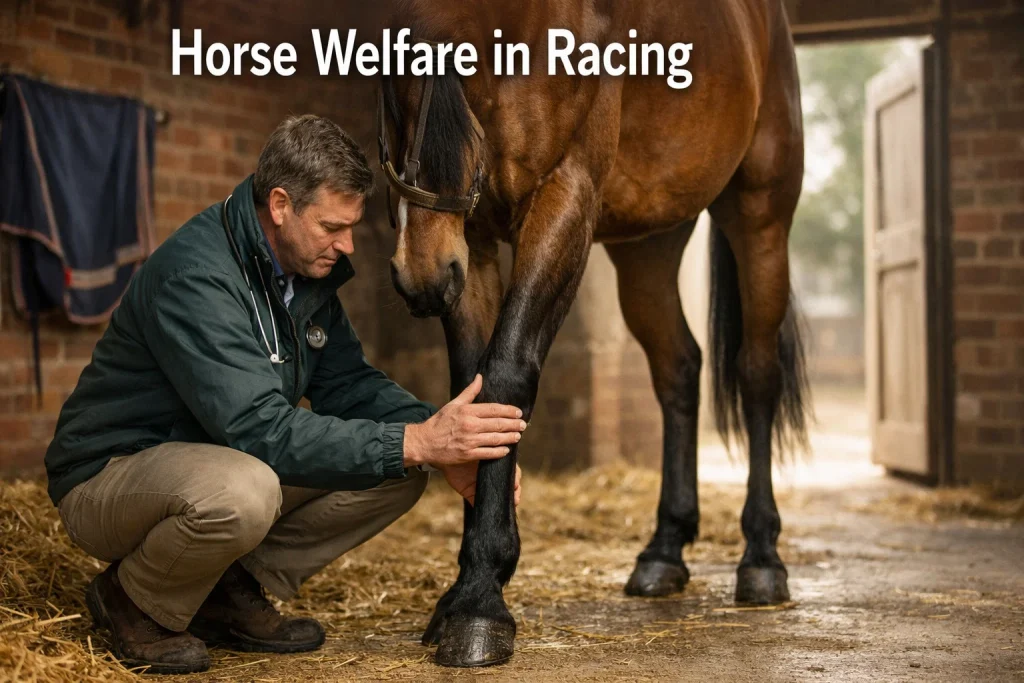
On-course veterinary provision has expanded significantly. Every race meeting in Britain is attended by qualified veterinary surgeons who inspect horses before racing (trot-ups and pre-race veterinary checks), monitor the field during the race, and assess any horse that is pulled up, falls or shows signs of distress post-race. The veterinary team has the authority to withdraw a horse from any race if they judge it unfit to compete — a decision that appears on the racecard as a late non-runner with a welfare-related explanation.
The aftercare of retired racehorses is another area where investment has increased. Retraining of Racehorses (RoR), the sport’s official charity for ex-racehorses, receives funding from the industry and works to rehome horses that have finished their racing careers. The aftercare pipeline does not appear on the racecard, but it forms part of the lifecycle that the racecard represents: a horse’s name appears on the card for a defined period of its competitive life, and the industry’s responsibility extends beyond the final race entry.
What Welfare Means for the Racecard Reader
For the punter reading a racecard, welfare manifests in several practical ways that affect the card’s content and reliability.
Non-runners for welfare reasons are among the most common late changes to a racecard. A horse may be withdrawn on race morning after a veterinary inspection reveals a minor issue — lameness, a respiratory concern, a reaction to the going. These non-runners are flagged on digital racecards, usually with the notation “veterinary” or “welfare” beside the withdrawal. For the punter, a welfare non-runner removes a runner from the field and triggers a Rule 4 deduction on remaining bets, but the underlying message is positive: the system is working as designed, prioritising the horse’s health over the race entry.
Going changes for safety are another welfare-related adjustment that affects the racecard. The clerk of the course has the authority to change the going description, water the course, or in extreme cases recommend the abandonment of a meeting if the ground conditions pose an unacceptable risk. Going changes between the overnight card and race morning are sometimes driven by welfare considerations rather than purely by weather — a course may water not to improve the racing surface but to reduce the firmness that increases injury risk.
Pre-race veterinary checks are not visible on the racecard itself, but they determine who appears on it. Every horse that races in Britain must pass a trot-up inspection, and any horse returning from injury or a long absence may face additional scrutiny. These checks operate as a filter between the declaration stage and the race itself, and they ensure that the runners you see on the card have been cleared to compete by qualified professionals.
The data shows improvement across every measurable welfare metric. For the racecard reader, that improvement is the quiet assurance that the document you are studying represents a system where risk is managed, monitored and progressively reduced — not ignored.