
Racecard Anatomy: What Every Section of a UK Racing Card Tells You
Best Horse Racing Betting Sites – Bet on Horse Racing in 2026
Loading...
A racecard explained in full is something most punters never bother with. They glance at the form, check the odds, maybe note the going, and move on. That approach works right up until the moment it doesn’t — when the horse they backed was carrying a 7lb penalty they didn’t notice, or when the low draw at Chester quietly decided the race before the stalls opened.
Every UK racecard is a compressed briefing document. It packs the identity of each runner, the context of the race itself, the recent competitive history of every horse in the field, and the market’s real-time assessment of their chances into a format that fits on a single screen or a folded sheet of paper. The information is all there. The question is whether you know where to look and what each piece actually tells you.
This guide breaks down a standard UK racing card section by section, moving from the header at the top — where time, course, class and conditions live — through the runner blocks in the middle, and down to the columns that carry form figures, draw positions, weights, odds, and trainer-jockey statistics. Each element earns its space on the card for a reason, and understanding that reason is the difference between reading a racecard and actually using one. By the end, the card should feel less like a wall of abbreviations and more like a conversation between you and the race.
The Visual Guide: How a Racecard Is Structured
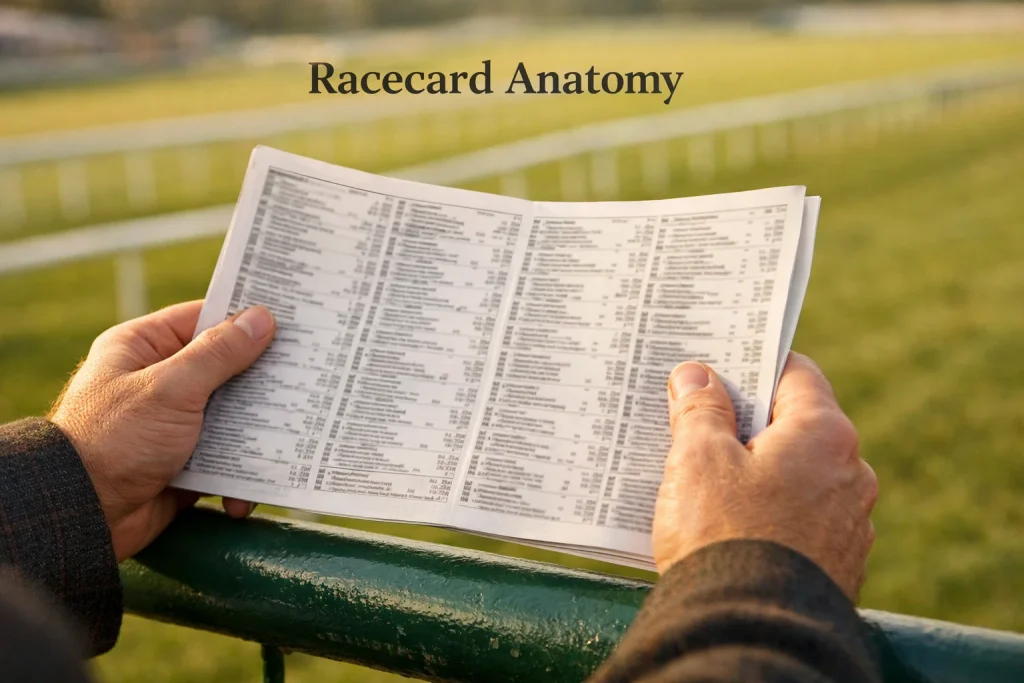
Open any UK racecard — whether on Racing Post, Sky Sports Racing, Sporting Life or one of the course-specific platforms — and you’ll see the same basic architecture. The layout varies cosmetically between providers, but the bones are identical because the underlying data comes from the same source: the official declarations filed with the British Horseracing Authority.
At the top sits the race header. This is the frame around the picture: time of the race, the course hosting it, the class and type of contest, the distance, the going, and the total prize money on offer. None of this information relates to any individual horse. It describes the race itself — the stage before the actors appear.
Below the header, the card opens into rows of runner information. Each row represents one horse. Within that row, you’ll typically find the runner’s number and draw, the horse’s name and age, the silks carried by the jockey, the weight allocated, the official rating (in handicaps), the jockey’s name, the trainer’s name, and the form string. Some platforms expand these rows with additional columns — speed ratings, days since last run, course-and-distance records — but the core data points remain consistent.
The UK currently operates 59 racecourses, running Flat, National Hunt and all-weather fixtures across a calendar that stretches from January to December. Each course may present its racecard with minor formatting differences, but a runner row at Cheltenham contains the same essential categories as one at Wolverhampton. That consistency is deliberate. The BHA’s declaration process standardises the information, and the racecard is the public-facing translation of that standardised feed.
At the foot of each runner row — or sometimes adjacent to it — you’ll find market data: the current odds, the forecast price, or the live exchange position. This column tells you something different from everything above it. Where the header and runner blocks deal in facts (the horse is six years old, the distance is ten furlongs, the going is good to soft), the odds column deals in opinion — the market’s aggregated opinion of how those facts translate into probability.
Think of the racecard as three layers stacked vertically. Layer one: race context (the header). Layer two: participant data (the runner blocks). Layer three: market assessment (the odds). Every piece of analysis you do, from a quick punt to a systematic approach, involves reading across those three layers and asking whether the price reflects what the data tells you.
Race Header: Time, Course, Class, Distance, Going and Prize Money
The header is the first thing you see, and the last thing many punters actually read. That’s a mistake. Before you assess a single horse, the header tells you what kind of race you’re looking at — and that context shapes everything that follows.
Time and course are straightforward, but they matter more than they appear to. A 2:30 at Ascot on a Saturday in June is a fundamentally different proposition from a 2:30 at Wolverhampton on a Monday evening. The course dictates the surface, the configuration (left-handed, right-handed, sharp turns or galloping track), and the quality of field the race is likely to attract. The time slot matters because the BHA has worked systematically to reduce scheduling clashes: the proportion of Saturday races overlapping before 5pm dropped from 11.1% in 2022 to just 5.8% in 2026. Fewer clashes mean more focused fields and, for the punter, cleaner data to work with.
As Richard Wayman, BHA Director of Racing, put it: “The volume of fixtures and races remains largely consistent with last year, but the race programme will fluctuate as more agile planning allows us to better tailor supply to the needs of the horse population.” That philosophy — adjusting the programme to the available horses rather than forcing horses into a fixed schedule — directly affects what you see in the header. When the BHA moves a race or adjusts a fixture, the ripple effect reaches every racecard printed that day.
Class is where casual readers often tune out, but it’s one of the most informative elements on the card. UK races are graded from Class 1 (Group races and Grade 1 events) down to Class 7 (the lowest level). The class tells you the quality band of the runners: a horse that ran well in a Class 2 last time out is operating at a different level from one with a similar finishing position in a Class 5. If you’re comparing form figures between two horses, the class of each previous race is essential context. A “3” in a Group 3 is not the same as a “3” in a Class 6 handicap. Not even close.
Distance is listed in miles and furlongs. One mile equals eight furlongs. Races on the Flat typically range from five furlongs (a pure sprint) to two miles four furlongs (a stamina test), while National Hunt contests extend further. This column tells you whether the race suits front-runners or closers, whether pace in the early stages will be fierce or sedate, and whether certain horses in the field have proven stamina at the trip. Check it against each runner’s form — a horse stepping up from a mile to a mile and a half for the first time is making a significant leap, and the racecard is the only document that shows you both pieces of information side by side.
Going describes the ground condition on race day. The scale runs from Hard (extremely firm, rare and usually avoided) through Firm, Good to Firm, Good, Good to Soft, Soft, to Heavy (waterlogged). On all-weather surfaces, the going is reported as Standard, Standard to Slow, or Slow. The going affects everything: which horses have a proven affinity for the surface, how much energy they’ll expend, and whether front-runners or hold-up horses gain the advantage. It’s measured by a penetrometer device called the GoingStick and updated throughout the day, so the going you see on the card at declaration time may change by post time.
Prize money rounds out the header. The total purse tells you where the race sits in the financial hierarchy. A maiden with £5,000 on offer attracts a different calibre of runner from a listed race with £75,000. For the punter, prize money is a proxy for competition intensity — bigger pots draw better-prepared horses and sharper trainers. The relationship isn’t always linear, but it’s a reliable signal.
Runner Information Block: Name, Age, Silks and Number
Each horse gets its own row, and the first thing that row tells you is who this animal actually is. The runner number (cloth number) is assigned by the BHA and corresponds to the number on the saddlecloth the horse carries. It determines betting shop ticket references and, on most platforms, the order in which runners appear on the card. Don’t confuse the runner number with the draw — they are separate pieces of information, though they sometimes coincide.
The horse’s name follows standard Thoroughbred naming conventions. Names are registered with Weatherbys, the breed’s official record-keeper in the UK, and each name is unique within a specific timeframe. On some racecards, the name is accompanied by breeding information: sire (father) and dam (mother), sometimes with the dam’s sire in parentheses. This column tells you lineage. To most recreational punters, breeding is background noise, but to serious form students, the sire line can indicate likely going preferences, distance aptitude, or rate of physical maturity. A son of Frankel, for example, tends to improve with age and distance. A daughter of Kodiac is more likely to be a precocious sprinter.
Age is listed in years, and it matters more than you might think. All Thoroughbreds in the Northern Hemisphere share an official birthday of January 1st, regardless of when they were actually born. A two-year-old on the card might be a late-April foal running in June — barely past its second birthday — or an early-January foal with a five-month developmental advantage over the youngest in the field. On the Flat, age is critical in juvenile and three-year-old races, where physical maturity can outweigh raw ability. Over jumps, age tells you about experience and durability: a six-year-old chaser is in its prime; a twelve-year-old is a veteran whose best days may be behind it.
The silks column shows the colours and pattern worn by the jockey, which identify the horse’s owner. Silks are registered with Weatherbys and are unique to each ownership entity. For the racecard reader, the silks are primarily a visual identification tool — they help you spot your horse on a TV screen or track camera. But they also carry ownership information, and ownership can occasionally be a form angle in its own right. A horse recently transferred to a powerful owner-breeder operation like Godolphin or Coolmore may be about to receive a significant upgrade in competition and preparation.
Some racecards include a headgear column adjacent to the name. This tells you whether the horse is wearing blinkers, a visor, cheekpieces, a hood, or a tongue tie. These are abbreviated (b, v, p, h, t respectively), and a superscript “1” means it’s the first time the horse has worn that piece of equipment. First-time headgear — blinkers in particular — is one of the most tracked angles in racecard analysis, because the improvement rate for horses wearing blinkers for the first time is measurably higher than average. This column tells you something the form line alone cannot: that the connections are trying something new.
The Form Line: A Quick Reference
The form string is the most information-dense element on the racecard, and it deserves a detailed treatment of its own. For the purposes of understanding the card’s anatomy, though, here’s what you need to know about where it sits and what it does.
The form line appears as a sequence of numbers and letters, typically reading right to left in chronological order (most recent run on the right). The numbers 1 through 9 represent finishing positions. A “0” means the horse finished tenth or worse. Letters represent non-completions or status markers: P for pulled up, F for fell, U for unseated rider, R for refused, S for slipped up. The slash “/” separates different racing seasons, so “21/305” tells you the horse ran twice last season (finishing second and first) and three times the season before.
What this column tells you is deceptively simple: how the horse has performed recently. But reading it properly requires context from other parts of the card. A form figure of “2” looks decent in isolation — but was that second place in a Class 2 at York or a Class 6 at Catterick? Was it on heavy going or firm? Was the horse carrying top weight or running off the minimum? The form line is the starting point for analysis, not the conclusion. It compresses the story; the rest of the card — class, going, weight, distance — fills in the gaps.
Some platforms annotate the form line with additional indicators. The letters C and D next to the form (or in a separate column) mean the horse has won at this course (C) or over this distance (D). CD means both. BF means beaten favourite — the horse was market leader in a recent race and lost, which can indicate either bad luck or an overrated animal. These annotations turn the form from a simple sequence of finishes into a layered profile of the runner’s history, all compressed into a handful of characters.
The form line is the heart of the racecard. Every other column either provides context for reading it or offers an alternative angle that complements what the form says. Treat it as the starting question — not the final answer.
Draw and Stall Position Column
The draw column shows the starting stall number assigned to each horse. In Flat racing, horses break from numbered stalls; in National Hunt, they line up behind a tape, so the draw is irrelevant for jump races and won’t appear on those cards. On the Flat, however, this column tells you something that no amount of form analysis can override: where the horse will be standing when the race begins.
Why does a number between 1 and 20 matter? Because racecourses are not symmetrical. A tight, left-handed course like Chester creates a geometry problem: a horse drawn wide on the outside has to cover more ground on every bend. Over five furlongs at Chester, the difference between stall 1 and stall 10 can be several lengths before any horse has done anything wrong. The data confirms it — at Chester in sprint races, horses drawn in stalls 1 to 3 win approximately 28% of the time, despite typically representing only 15 to 20% of the average field.
Not every course shows this kind of bias. Straight tracks (Ascot’s five furlongs, Newmarket’s Rowley Mile) distribute the advantage differently — sometimes the stand side is preferred, sometimes the far side, depending on the ground and where the freshest strip of turf lies. Round courses with long straights (Doncaster, Newbury) tend to produce less draw bias because horses have time to settle into position regardless of stall.
This column tells you whether the race’s result might be partly pre-determined by the draw allocation. On a low-bias course over a mile and a half, the draw is noise — worth noting but not worth weighting heavily. On a high-bias course over five furlongs, it’s signal. The skill is knowing which category your race falls into, and the draw column is the data point that unlocks that analysis.
Look at the draw in conjunction with the field size. A draw of 12 in a field of 14 is a very different proposition from a draw of 12 in a field of 12 — in the latter case, you’re on the outside of the entire field. The racecard shows you both numbers. It’s up to you to connect them.
Odds Column: Reading Market Signals
Everything to the left of the odds column on a racecard deals in facts. The horse is five years old, it’s carrying 9st 2lb, it drew stall 4, and its last three form figures read 213. These things are true and settled. The odds column is different. It deals in probability as expressed by money — and probability, unlike facts, changes by the minute.
On most UK racecards, the odds column shows either the current market price (if you’re viewing a live card close to race time) or a forecast price assembled by a bookmaker’s compiler. The format is fractional: 5/1 means you receive five pounds for every one pound staked, plus your stake back. Some platforms offer decimal equivalents (6.0 for 5/1), which makes comparison easier but still represents the same underlying assessment.
What this column tells you is how the betting market collectively rates each runner’s chance of winning. A horse at 2/1 is considered to have roughly a 33% implied probability. A horse at 20/1 has about a 5% implied probability. These numbers carry the aggregated opinions of bookmakers, professional gamblers, syndicates, and the general public. The market isn’t always right — favourites in UK racing win only about 30 to 35% of the time — but it’s the most efficient single predictor available.
The average Flat field in 2026 contained 8.90 runners, while the average jump race had 7.84. In larger fields, the spread of odds widens — you’ll see a tighter market leader and a longer tail of outsiders. In smaller fields, prices compress and the favourite carries a higher implied probability. This column tells you the shape of the market, which in turn tells you how competitive the race is likely to be.
Price movements matter too. A horse that opened at 8/1 in the morning and is now 5/1 at post time has been “backed” — money has come for it, shortening the price. That movement might reflect stable confidence, a positive veterinary report, or simply a popular tipster’s recommendation. A horse drifting from 3/1 to 6/1 is the opposite story: the market has lost faith. Some racecard platforms show a price arrow (up or down) next to the current odds, which gives you this movement at a glance. Others require you to check multiple times as the race approaches.
The odds column is the market’s summary of everything else on the card. It weighs form, going preference, class, trainer intent, jockey booking, and a thousand other factors into a single number. Reading it alongside the rest of the card is the fundamental act of racecard analysis — you’re asking whether the price reflects what you see, or whether the market has missed something.
Trainer and Jockey Statistics
The trainer and jockey columns do double duty. At their simplest, they tell you who trains the horse and who rides it. But on most modern racecard platforms, they also display recent performance statistics — a trainer’s strike rate over the past 14 days, a jockey’s win percentage at the course, or the combined record of the trainer-jockey partnership.
The trainer column typically shows the trainer’s name, their seasonal win record (something like “34/210” meaning 34 wins from 210 runners), and sometimes a strike rate percentage. What this column tells you is whether the yard is in form. A trainer sending out winners at 20% or above is running hot. A yard at 5% may be struggling with a virus, poor ground, or simply a weak string. Seasonal form fluctuates — some trainers peak in spring with their three-year-olds, others dominate the autumn jumps season — so the stat is a snapshot, not a permanent verdict.
Trainer intent is one of the underappreciated angles in racecard reading. A top trainer entering a horse in a Class 5 handicap at a minor Monday fixture is sending a signal. They wouldn’t waste the entry fee and the transport cost unless they expected the horse to be competitive. Conversely, a big-name trainer entering a horse at a Premier meeting against top-class opposition is testing the water — and the racecard, by showing you the trainer’s name against the class of the race, gives you the raw material to make that inference.
The jockey column works similarly, but with an additional element: the jockey’s claim. An apprentice jockey on the Flat or a conditional jockey over jumps receives a weight allowance — typically 7lb, 5lb, or 3lb depending on the number of career wins. This claim is marked on the racecard next to the jockey’s name. A horse carrying 9st 2lb with a 5lb claimer actually carries 8st 11lb, which can be a significant advantage in a handicap. This column tells you not just who is riding but whether that rider brings a tangible weight benefit.
The trainer-jockey combination matters as much as either individual statistic. Certain partnerships produce results that exceed what either party achieves independently. A trainer with a 12% strike rate and a jockey with a 15% strike rate might combine for 22% when they work together — a synergy the racecard reveals if you know to look for it. Some platforms display this combination stat directly; others require you to cross-reference trainer and jockey manually.
Putting It All Together: Reading a Card From Top to Bottom
Here’s how a complete racecard read works in practice. Imagine a hypothetical race: the 3:15 at York, a Class 2 handicap over a mile on Good to Firm going, with £30,000 in prize money. The field has ten runners.
Start with the header. Class 2 tells you this is a competitive handicap — the horses are rated in the mid-to-high range, and the prize money confirms the quality. A mile on Good to Firm at York means a flat, galloping track with no significant draw bias over this trip, and ground that favours horses with proven form on a quick surface. Already, before looking at a single horse, you’ve established the parameters of the race.
Move to the runners. Scan the form figures first. You’re looking for recent form — a horse with 1221 on the right side of its form line is in different shape from one showing 0760. But remember the class context from the header: the horse showing 1221 might have achieved those results in Class 4 and 5 company, and now faces a sharp step up. The horse showing 0760 might have been competing in Class 1 and is dropping down. The form tells the story; the class tells you the edition.
Check the weight column. In this hypothetical Class 2 handicap, the top weight is carrying 9st 12lb and the bottom weight 8st 5lb — a spread of 21lb. The BHA handicapper believes that weight spread equalises the field. Your job is to decide whether the handicapper got it right or whether one horse is well treated. A horse on an upward trajectory in the form line, carrying a relatively low weight, might be ahead of the handicapper — the official rating hasn’t caught up with the horse’s improvement. That’s a racecard angle the numbers hand to you, if you read the weight alongside the form.
Now look at the jockey bookings. A leading jockey choosing to ride a 10/1 shot over a 3/1 shot in the same race is a statement. Jockeys have limited rides per day, and top riders pick their mounts with intent. If the stable jockey has been replaced by a claiming apprentice, that might signal the trainer is using the claim strategically to reduce weight — or it might suggest the stable doesn’t expect much from this runner. Either way, this column tells you something about connections’ expectations.
Finally, check the odds. Does the market’s assessment match what you’ve seen? If your form-and-weight analysis suggests a horse should be around 6/1, and the market has it at 12/1, that’s a potential discrepancy. If the market has it at 3/1 and you had it at 6/1, you might be missing something — or the market might be overreacting to a name or a trainer’s reputation.
That’s the anatomy of a racecard in action. Header for context. Runners for data. Odds for the market’s verdict. The card puts it all in front of you. The rest is analysis.