
Best Odds Horse Racing Today: How to Compare Prices on the Racecard
Best Horse Racing Betting Sites – Bet on Horse Racing in 2026
Loading...
The odds column on a racecard is not decoration — it is the market’s real-time verdict on every horse’s chance, and understanding how to read and compare those numbers is the difference between paying market price and getting value. Finding the best odds on horse racing today means knowing where to look, what format the prices are in and why they vary between providers.
The scale of the market behind those odds is significant. Online horse racing betting in the UK generated £766.7 million in gross gaming yield in the 2026-2026 financial year, making it the second largest betting vertical after football. That revenue flows through the odds column — every price on every racecard represents a bookmaker’s margin, and the punter who compares prices across operators consistently returns more than the punter who takes the first number offered.
The price tells you what the market thinks. What you do with that information depends on whether you simply accept the market’s verdict or interrogate it against the racecard data sitting right beside it.
How Odds Appear on a Racecard — Formats and Sources
UK racecards display odds in one of three formats, and sometimes all three simultaneously. Understanding the format is the first requirement before you can compare prices effectively.
Fractional odds are the traditional British format. A horse at 5/1 (spoken as “five to one”) returns five pounds of profit for every one pound staked, plus the original stake. At 11/4, the return is eleven pounds for every four wagered. The numerator is the potential profit; the denominator is the stake. Fractional odds dominate on-course bookmakers and remain the default on most UK racecard platforms, largely because they have been the standard since the 18th century and British punters still think in fractions.
Decimal odds express the total return per unit staked, including the stake itself. A horse at 6.00 in decimal is the same as 5/1 in fractional — a one-pound bet returns six pounds total (five profit plus the original pound). Decimal odds are standard on betting exchanges and are increasingly available on bookmaker racecards as a toggle option. They make comparison easier because the bigger number always means the bigger return, without the mental arithmetic that complex fractions require.
Exchange prices appear on platforms like Betfair and Betdaq, where punters bet against each other rather than against a bookmaker. Exchange odds tend to be slightly larger than bookmaker odds because the exchange takes a commission on winning bets (typically 2 to 5 percent) rather than building a margin into the price itself. On a racecard that aggregates prices from multiple sources, the exchange price often appears as a separate column or is flagged with a different colour.
The other distinction that matters on the racecard is the difference between forecast prices and the starting price (SP). Forecast prices are published in the morning by on-course reporters and updated throughout the day as the market develops. They are estimates of what the odds will be at the off. The SP is the actual price returned at the moment the race starts, determined by the on-course market. If you bet at a fixed price in the morning and the SP is shorter at race time, you have secured value. If the SP is longer, you have overpaid — unless your bookmaker offers Best Odds Guaranteed, which we will cover next.
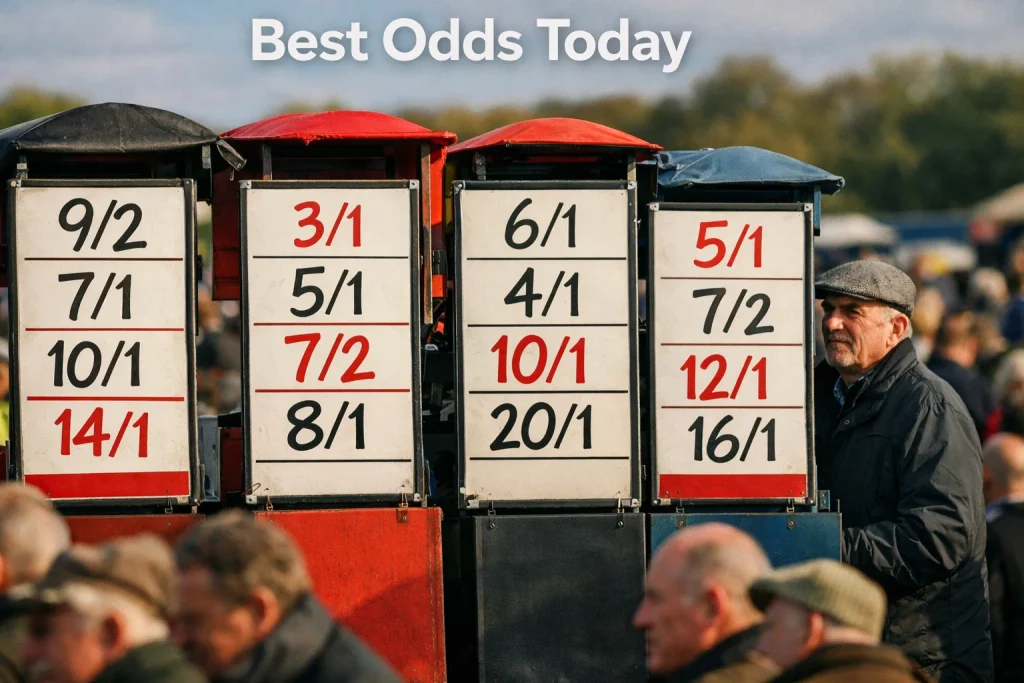
Most digital racecards show live bookmaker prices in a grid format — one column per operator — which allows direct comparison. The same horse might be 9/2 with one firm and 4/1 with another; that difference, over hundreds of bets, compounds into a material impact on your returns. The price tells you what each bookmaker thinks, but it also tells you where the market disagrees, and disagreement is where value lives.
Comparing Prices Across Bookmakers
The simplest way to find the best odds on any horse racing card today is to compare the same selection across multiple bookmakers. Most major racecard platforms — including Racing Post, Sporting Life, At The Races and Oddschecker — display a price grid showing each bookmaker’s odds side by side. The highest number in the row is the best price available at that moment. Taking the best price every time is not a strategy; it is basic arithmetic, and the cumulative effect over a season of betting is substantial.
Best Odds Guaranteed (BOG) is a promotion offered by most major UK bookmakers that eliminates one of the punter’s classic dilemmas. Under BOG, if you take a fixed price in the morning and the SP is higher, the bookmaker pays you at the SP instead. This means you can take the best available price at any point during the day, knowing that if the market moves in your favour, you benefit. BOG effectively turns early price-taking into a free option — you lock in today’s price with the upside of a potential increase.
Not all BOG offers are identical. Some bookmakers cap the maximum additional payout; others exclude certain race types or bet sizes. The terms appear in the small print, and they matter more than the headline claim. On the racecard, BOG availability is sometimes flagged with a small icon beside the bookmaker’s price column, but not always — it is worth knowing which operators offer it as a standard feature.
The context for price comparison has shifted in recent years. Betting turnover on British racing dropped 4.2 percent in the first three quarters of 2026 versus the prior year, with turnover per race declining even further, according to the BHA Racing Report Q3 2026. A shrinking market means bookmakers are competing harder for the punters who remain, and that competition manifests partly in odds — some firms will offer marginally larger prices on selected races to attract volume. The racecard price grid captures these differences in real time, and the punter who checks it before placing a bet is the one who benefits.
Each-way betting adds another layer to price comparison. An each-way bet is two bets in one — a win bet and a place bet at a fraction of the odds (typically 1/4 or 1/5 depending on field size). The place terms vary by bookmaker and by race, and they are not always displayed on the racecard itself. A horse at 10/1 with one-fifth the odds for a place is a different proposition from the same horse at 10/1 with one-quarter the odds. For each-way punters, the place terms can matter as much as the headline price.
Price Movements — What Shortening and Drifting Signal
Odds on a racecard are not static. From the moment the forecast prices are published to the second the starting stalls open, the numbers move — sometimes gradually, sometimes violently. Reading those movements is a skill that separates price-aware punters from passive ones, and the racecard’s odds column is where you see it happen.
A horse whose price shortens — moves from, say, 8/1 to 5/1 — is being backed. Money is flowing onto that selection, and bookmakers are cutting the odds to reduce their liability. Shortening can be driven by public sentiment, tipster activity, or informed money from connections (owners, trainers, stable staff) who believe the horse has a strong chance. The price tells you that confidence is rising, though it does not tell you why. That is where the racecard fills in the picture: if a horse is shortening and its form, going and draw all support a strong performance, the market and the data are aligned.
A horse that drifts — moves from 5/1 to 8/1 — is being avoided. Either money is not coming for it, or money is actively being placed on other horses in the same race, pushing their prices down and this one up by implication. Drifting is not always negative. Sometimes a horse drifts because its morning price was too short — the market overreacted to a newspaper tip or a social media buzz, and the correction is simply the odds finding their natural level. But a late drift, in the final minutes before a race, is generally a warning sign. The people closest to the horse are not backing it.
A steam move (also called a gamble) is a sudden, sharp shortening — a horse going from 12/1 to 6/1 in a matter of minutes. Steam moves attract attention because they often indicate that significant money has arrived from sources perceived to have inside knowledge. Not every steam move wins, and the track record of gambled horses over large samples is mixed, but a horse that shows a steam move and also ticks the racecard’s boxes — strong recent form, suitable going, favourable draw — deserves serious consideration.
Market movers lists, published by bookmakers and racecard platforms, aggregate the biggest price changes across a day’s racing and present them as a shortlist. These lists are useful as a starting point, not as a strategy. A market mover identified at 10am may have already been backed into a shorter price by the time you see it, and the value that existed at the original price may have evaporated. The price tells you what happened in the market; the racecard tells you whether the market’s judgement is sound. Together, they give you the complete signal. Separately, each one is only half the story.