
Royal Ascot Racecard Guide: Reading Flat Racing’s Premier Cards
Best Horse Racing Betting Sites – Bet on Horse Racing in 2026
Loading...
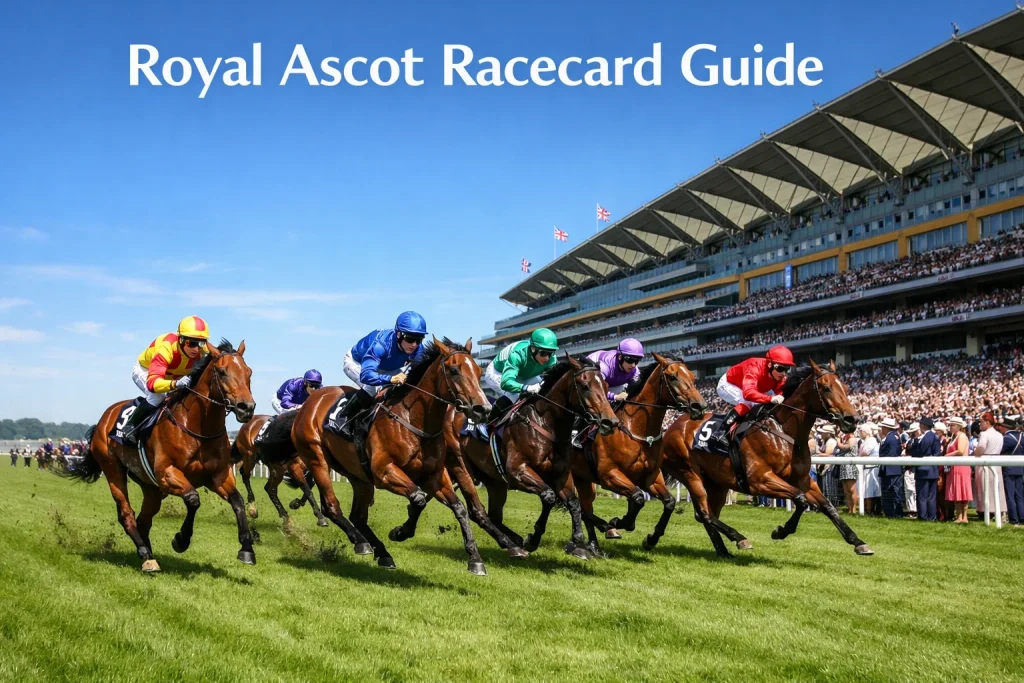
Royal Ascot racecards carry the highest density of Group-race form in Flat racing anywhere in the world. Five days in June where classic winners, international raiders from a dozen countries, unexposed three-year-olds and seasoned handicappers appear on the same programme. For anyone trying to read an Ascot racecard during Royal Week, the volume and quality of information on the card is a step above anything else the Flat calendar produces.
The meeting features 35 races across its five days, ranging from Group 1 championship events — the Queen Anne, the King’s Stand, the Gold Cup, the Diamond Jubilee — to heritage handicaps like the Royal Hunt Cup and the Wokingham, which attract maximum fields and some of the most competitive betting races of the year. On the Royal Ascot card, you will see form flags from Meydan, Longchamp, the Curragh, Santa Anita and Tokyo sitting alongside Newmarket and York form. Parsing those international form lines requires a different set of reference points than a standard domestic card.
This guide covers the specific features of Royal Ascot racecards: the international dimension, the draw bias that varies dramatically between Ascot’s two course configurations, and how to read Group-race form when the field is packed with the best horses in training.
Ascot Card Specifics — International Fields and Group Entries
The defining feature of a Royal Ascot racecard is the international composition of its fields. In a typical Group 1 at the meeting, runners trained in Ireland, France, the United States, Japan, Australia and the Middle East can appear alongside British-trained horses. Each international runner carries a country suffix after its name — (IRE), (FR), (USA), (JPN), (AUS) — and its form line references races at overseas tracks that most UK punters will not have watched.
Reading international form on the Ascot card requires context rather than memorisation. Irish form translates most directly, because the grading system mirrors the British structure and the horses often compete against each other at other meetings throughout the year. French form, particularly from Longchamp and Chantilly, also translates reasonably well at the Group level, though the racing style in France — often slower early pace and a sprint finish — differs from the more evenly run British pattern. American, Japanese and Australian form is harder to calibrate, and for these runners, the racecard’s official rating and the Racing Post Rating become more important than the form figures, because the rating provides a cross-border comparison that raw finishing positions cannot.
The prize money behind Royal Ascot reinforces the international draw. Premier Racedays in 2026 saw prize fund allocations increase by £7.33 million, and Royal Ascot represents the flagship of that Premier programme. The financial incentive brings the best horses in the world to Berkshire, and the racecard reflects that through fields of 10 to 14 runners in Group 1 events and fields of 20 to 30 in the big handicaps.
For handicap races at the meeting, the card takes on a different character. The Royal Hunt Cup (one mile, 30 runners), the Wokingham (six furlongs, 25-plus runners) and the Britannia (one mile, 30 runners for three-year-olds) are among the most competitive handicaps in the calendar. These races produce racecards with dense form lines, tight official rating bands and field sizes that demand close attention to the draw — a factor that varies dramatically depending on which part of the Ascot track the race uses.
Draw at Ascot — Straight Course vs Round Course
Ascot has two distinct course configurations, and the draw bias differs substantially between them. Understanding which configuration applies to each race is essential when reading the Ascot racecard, because a stall number that is advantageous on the straight course may be neutral or disadvantageous on the round course.
The straight course is used for races up to and including one mile. Horses start at the far end of a straight track and run directly toward the grandstand. On this course, draw bias depends heavily on the going and the field size. When the ground is soft and the field is large, horses drawn high (towards the stands’ rail) have historically shown an advantage, because the ground near the far rail tends to be more churned up by earlier races. When the ground is firm and even, the bias is less pronounced. The draw column on the racecard becomes critical for straight-course races with 20-plus runners, where a horse drawn in stall 1 faces a fundamentally different journey from one drawn in stall 25.
Draw bias data from courses with similar characteristics demonstrates how significant stall position can be. At Chester, for instance, horses drawn in stalls 1 to 3 over sprint distances win approximately 28 percent of races despite representing only 15 to 20 percent of the average field. Ascot’s straight course does not produce bias as extreme as Chester’s, but in large handicap fields on soft ground, the effect is measurable and the racecard’s draw column should be read as a core variable rather than a footnote.
The round course is used for races beyond a mile — the Gold Cup over two and a half miles, the Hardwicke over a mile and a half, and several other Group races and handicaps. On the round course, runners start on a spur and join the main track after a sweeping right-hand bend. The draw has less impact here because the field has time to sort itself out through the bend before the straight. In smaller fields (eight to twelve runners), the draw is largely irrelevant on the round course. In larger fields, a low draw can offer a marginal advantage on the inside rail through the turn, but the effect is modest compared to the straight course.
On the Royal Ascot card, the draw column appears for every Flat race, but its importance varies by race. For the Wokingham (six furlongs, straight course, 25 runners), the draw is a primary analytical factor. For the Gold Cup (two miles four furlongs, round course, 12 runners), it is background information. Reading the Ascot card means knowing which course configuration each race uses and weighting the draw column accordingly.
Reading Group Race Form on the Ascot Card
Group-race form at Royal Ascot presents a particular challenge: the form lines are strong, the margins between horses are small, and the standard form-reading approach of simply comparing finishing positions breaks down when every runner in the field has high-class credentials.
The first adjustment is to read class rather than position. A horse that finished fourth in a Group 1 at Newmarket has arguably achieved more than one that won a Group 3 at Nottingham, even though the form figures read “4” versus “1.” On the Royal Ascot card, the official rating and the RPR help you make this distinction. A runner rated 115 that finished fourth in a Group 1 field of 112-rated horses and above is operating at a higher level than a runner rated 105 that won a weaker Group 3. The numbers on the card — OR, RPR, topspeed — provide the context that finishing positions alone cannot.
The second adjustment is pace analysis. Royal Ascot races, particularly over shorter distances, are often run at a strong, even pace because the quality of the field means multiple runners want to be prominent. Some racecards and form guides include pace indicators — whether a horse typically leads, races prominently or is held up. In a Group 1 sprint with ten front-runners, the pace is likely to be severe, which favours closers. In a tactical Group 1 over a mile where no runner wants to lead, the pace can be slow, which favours those with natural speed. The Ascot card does not always make pace explicit, but the running style of each horse can be inferred from its previous form comments.
The third adjustment is to account for unexposed runners, particularly three-year-olds stepping into open-age Group company for the first time. At Royal Ascot, the St James’s Palace Stakes and the Coronation Stakes pit classic-generation horses against older rivals, and these younger horses often have limited form — perhaps three or four lifetime starts. A three-year-old with a form line of 1-1-2 from three runs may lack the depth of form to compare directly with a five-year-old that has run twenty times, but the upward trajectory and the weight-for-age allowance (three-year-olds receive a significant weight concession against older horses) can make the younger horse a serious threat. On the Royal Ascot card, unexposed runners with rising ratings and limited mileage are often where the market finds value — and where the careful reader of the card finds an edge.