
Aintree and Grand National Racecard: What to Look For on the Card
Best Horse Racing Betting Sites – Bet on Horse Racing in 2026
Loading...
The Grand National racecard is unlike any other in British racing. Forty runners, handicap weights spanning two stones or more, unique fence names that appear nowhere else in the sport, and form that stretches across a three-year qualifying window. For anyone studying Aintree racecards for the first time, the sheer volume of information on the National card can feel overwhelming — but the principles of racecard reading still apply. They just operate at a larger scale.
Aintree’s three-day Festival in April is more than the National itself. The meeting features 13 other races across Thursday, Friday and Saturday, including Grade 1 contests over the Mildmay Course that use standard fences rather than the iconic National fences. But it is the National — the race that draws an estimated global television audience measured in hundreds of millions — that makes the Aintree racecard unique. The card for that race carries more variables than any other handicap chase in the calendar, and reading it with confidence requires an understanding of what makes it different.
This guide covers the specific features of the National card, the form indicators that matter most for the big race, and how the rest of the Aintree Festival card compares.
National Card Specifics — 40 Runners, Handicap Weights, Safety Measures
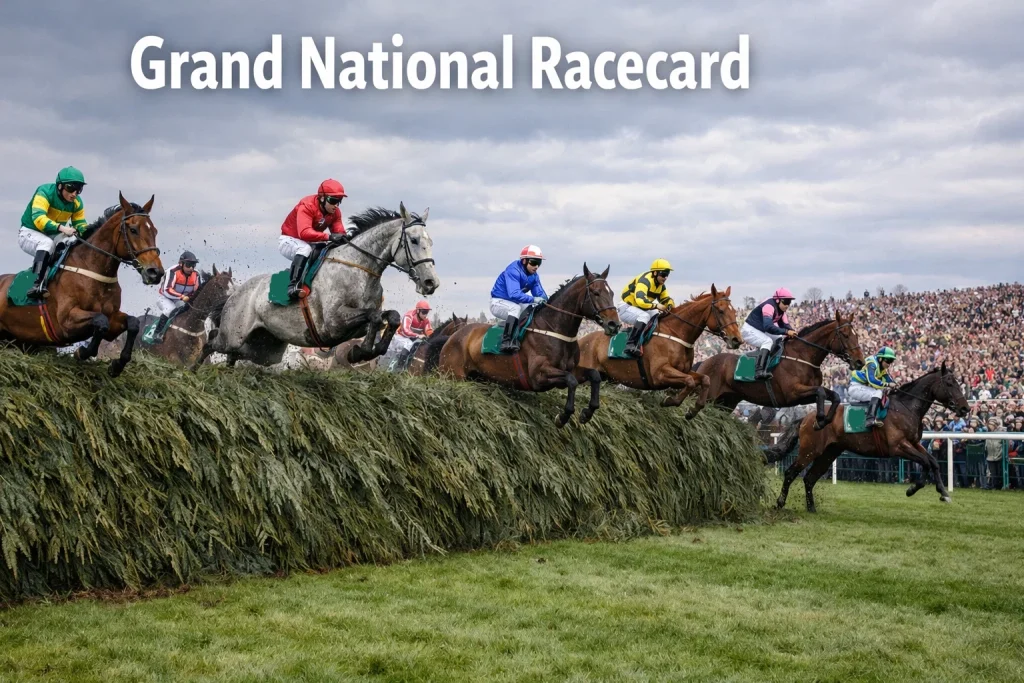
The Grand National is a handicap chase over approximately four miles and two furlongs, featuring 30 fences across two circuits of the National Course. The maximum field is 40 runners — the largest in British racing — and the card for that field is correspondingly dense. Every runner carries a weight assigned by the BHA handicapper, with the top weight typically carrying 11st 10lb and the bottom weight around 10st 0lb. That two-stone range is designed to equalise the chances across a field where the highest-rated horse may be 25 pounds of official rating above the lowest, and reading the weight column on the National card is essential to understanding the handicapper’s view of each runner’s chance.
Average field sizes across British jump racing stood at 7.84 runners per race in 2026, according to the BHA 2026 Racing Report. The National’s 40-runner field is roughly five times that average, and the analytical challenge scales accordingly. In an eight-horse novice hurdle, you can study every runner’s form in 15 minutes. In a 40-runner National, the same depth of analysis would take hours. The practical response is to filter: use the racecard to eliminate runners that fail on one or more key criteria (going, stamina, fence record, class) and focus your detailed analysis on the 10 or 12 that survive the filter.
Safety has been a central focus at Aintree for more than a decade, and the card reflects that emphasis. Fences have been modified, the field size has been debated (though 40 remains the maximum), and age restrictions apply — no horse younger than seven can run in the National, and no horse older than 12 may participate unless granted a specific exemption. These age limits appear on the racecard’s race conditions and serve as a first filter: any horse outside the 7-to-12 window is automatically excluded.
The broader safety trend in British racing is reflected in the data. In 2023, the BHA recorded 158 fatalities from 87,619 starts — a fatality rate of 0.18 percent, down from 0.20 percent in 2022. As Professor Tim Parkin of the University of Bristol has observed, the sustained improvement in these figures is a credit to everyone involved in the industry. At Aintree specifically, modifications to fences (including the removal of the most demanding obstacles and softening of the drops on the landing side), improved veterinary protocols and real-time monitoring have contributed to a measurably safer race. The racecard does not display safety data directly, but the race conditions section — detailing fence modifications, weight limits and veterinary oversight — reflects the infrastructure behind every runner’s participation.
Reading National Form — Stamina, Fences, Class
Form analysis for the Grand National requires a different weighting than form analysis for a standard handicap chase. Three factors dominate: stamina, fence record and class — and the racecard provides evidence for all three.
Stamina is the non-negotiable. The National is run over four miles and two furlongs, and no race in the regular calendar comes close to that distance. The nearest equivalent is the Scottish Grand National at Ayr (three miles seven furlongs) or the Welsh Grand National at Chepstow (three miles five furlongs). National form tells you whether a horse has the constitution to sustain its effort beyond the point where most races end. On the racecard, look for previous form at three miles or further, and pay particular attention to how the horse finished those races. A horse that won over three miles but was “staying on” at the finish is a stronger National candidate than one that won over the same distance but was “all out” — the language in the race comments, visible on most digital racecards, tells you whether there is more stamina in reserve.
Fence record is the second critical factor. The National fences are unique to Aintree’s National Course — taller and stiffer than standard chase fences, with a distinctive spruce top that horses must brush through rather than jump cleanly over. A horse’s jumping record at other tracks is relevant but not conclusive. What matters more is its record over the National fences specifically, and here the racecard helps: any horse that has completed the National course before (whether in the Grand National itself or in the Becher Chase in December, which uses the same fences over a shorter distance) will show that form in its line. The absence of National fence experience is not disqualifying, but it adds a layer of uncertainty that proven National-fence form removes.
Class matters because the National, despite being a handicap, attracts high-quality horses. Runners with official ratings in the 140s to 150s regularly contest the race, and these horses have typically won at Graded level. A horse that has never competed above Class 3 will find the National field a significant step up in quality, regardless of its handicap mark. National form tells you whether the horse belongs in this company, and the class indicator on the racecard — the grades and types of races in the form line — provides the evidence.
Aintree Beyond the National — Other Meeting Cards
The Grand National dominates the headlines, but the Aintree Festival features two full days of racing before Saturday’s main event, and the racecards for Thursday and Friday offer a different analytical profile entirely.
Thursday’s card (the Opening Day) and Friday’s card (Ladies Day) include Grade 1 races over the Mildmay Course — a separate, standard chase and hurdle track within the Aintree complex. The Mildmay Course uses regulation fences, not the National fences, and the distances are conventional (two miles to three miles). The racecards for these events look much like any other high-quality National Hunt card: field sizes of eight to fourteen, Graded form, and a going description that applies to the Mildmay Course specifically (which can differ from the National Course because the two tracks have different drainage characteristics).
Several of the non-National races serve as informative trials. The Topham Chase, run over the National fences but at a shorter distance (two miles five furlongs), appears on Friday’s card and produces runners that may return for the National the following year. The Foxhunters’ Chase, also over the National fences, is an amateur riders’ race that tests horses over the unique obstacles without the intensity of the National field. Form from these races is visible on any subsequent Aintree racecard and carries genuine predictive value for the National itself.
The Aintree Festival card as a whole offers three days of high-class National Hunt racing, but only Saturday’s centrepiece operates outside the normal racecard framework. For Thursday and Friday, standard form-reading principles apply without modification. For Saturday’s National, the adjustments described above — stamina filters, fence-record checks, class evaluation — are essential. The Aintree card rewards the punter who recognises which rules apply to which race, rather than treating the entire Festival as a single analytical challenge.