
Horse Racing Headgear Explained: Blinkers, Visors, Hoods and More
Best Horse Racing Betting Sites – Bet on Horse Racing in 2026
Loading...
A single letter next to a horse’s name on a racecard — b, v, p, h, t — signals a deliberate equipment decision by the trainer. Headgear abbreviations in horse racing are among the most overlooked columns on the card, yet they encode some of the most actionable information available. First-time headgear, in particular, is one of the strongest non-form signals a racecard can contain.
Every piece of headgear exists to solve a specific problem: a horse that loses concentration, one that hangs to one side, one that needs its airway cleared, or one that panics in the parade ring. The trainer’s decision to apply, change or remove headgear is not cosmetic. It is a targeted intervention, and the racecard records it with a letter that most punters glance at and few interrogate. Understanding what each letter signals — and, crucially, whether the equipment is being applied for the first time — gives you a reading of the card that goes beyond form, going and draw.
This guide covers every headgear type used in British racing, the statistical significance of first-time application, and how to read equipment changes as a signal of the trainer’s intent.
Every Headgear Type — What It Does and How It’s Coded
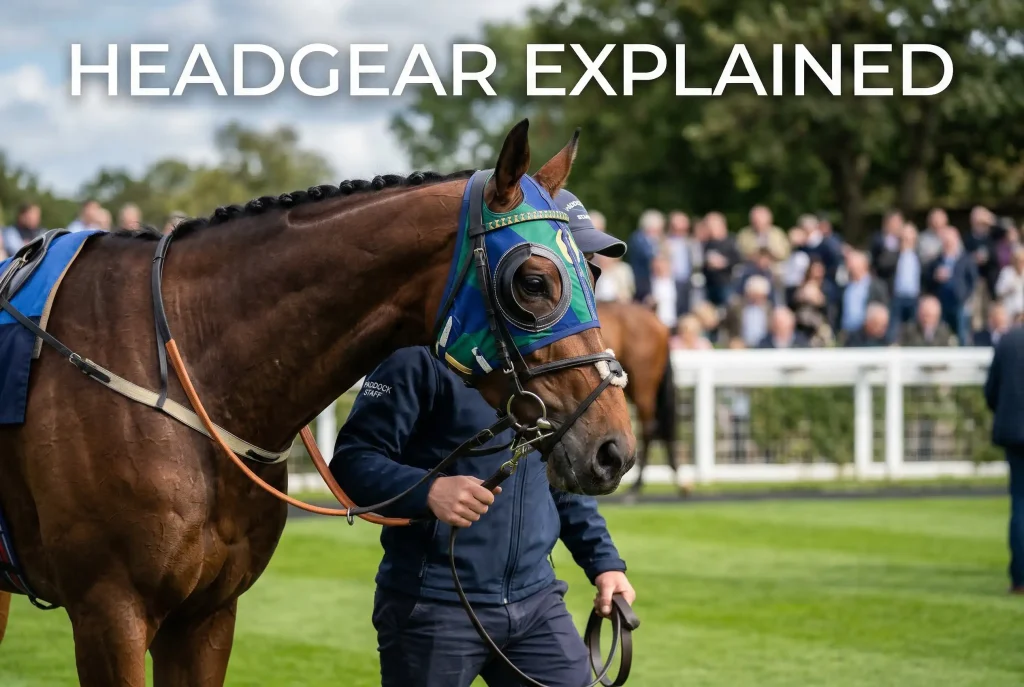
Blinkers (b) are rigid eye cups attached to the bridle that completely block the horse’s rear and peripheral vision, forcing it to look straight ahead. They are the most commonly applied piece of headgear in British racing and are primarily used on horses that idle in front, lose concentration mid-race, or are distracted by other runners alongside them. The letter signals a trainer who has identified a focus problem and is addressing it mechanically. Blinkers are a strong intervention — the horse’s field of vision is dramatically reduced — and the effect on performance can be immediate and significant.
Visors (v) are modified blinkers with a slit cut into one or both eye cups, allowing partial peripheral vision. They represent a middle ground between full blinkers and no headgear at all, and are often tried when a trainer wants to sharpen concentration without the full restriction that blinkers impose. Some horses respond better to visors than blinkers because the partial vision helps them settle in a field without becoming too focused or running too freely in the early stages.
Cheekpieces (p) are strips of sheepskin or synthetic material attached to the cheekstraps of the bridle, limiting the horse’s backward vision without covering the eyes. They are a softer intervention than either blinkers or visors and are increasingly popular in modern racing. The letter signals a trainer who wants to make a subtle adjustment rather than a dramatic one — often a horse that has shown a tendency to look around in the final furlong or hang towards the rail.
Hoods (h) cover the horse’s head, including the ears and sometimes the eyes, and are used primarily to keep nervous or highly strung horses calm before the race. Some horses wear hoods in the pre-parade ring and have them removed at the start; others race in them. The letter on the racecard indicates the hood will be worn during the race. For horses that are known to waste energy in the preliminaries — sweating, pulling, refusing to settle — a racing hood can preserve the energy that matters for the race itself.
Tongue ties (t) are straps that secure the horse’s tongue to its lower jaw, preventing it from retracting over the soft palate and obstructing the airway. Unlike other headgear, tongue ties address a physical issue rather than a behavioural one. A horse that makes a gurgling or choking noise during exercise may have its performance limited by a displaced tongue, and the tie is a non-surgical solution. The letter signals a breathing intervention, and its application has increased substantially in British racing over the past decade.
Eye shields (e) are a relatively recent addition to the racecard vocabulary. They are transparent or tinted covers that protect the horse’s eyes without restricting vision, used primarily in rainy or muddy conditions to prevent kickback from affecting the horse’s sight. Eye shields are less common than other headgear types and their application is typically weather-dependent rather than behavioural.
The most important modifier across all types is the number 1 appended to the letter. b1 means first-time blinkers; v1 means first-time visor; t1 means first-time tongue tie. This suffix is where the analytical value concentrates.
First-Time Headgear — The Statistical Edge
The first application of any headgear type produces, on average, a measurably stronger performance than repeat applications. This is one of the most documented effects in British racing analytics, and the racecard flags it with the “1” suffix specifically because the industry recognises its significance.
The mechanism is straightforward. When a trainer applies blinkers for the first time, the horse has never experienced the restricted vision before. The effect — increased focus, altered running style, reduced distraction — is at its maximum because the horse has no previous exposure to the equipment. Over subsequent runs in the same headgear, the horse adapts, the novelty diminishes, and the performance benefit fades. This is why the “1” matters more than the letter alone.
The impact varies by field size and race type. In larger fields — the average Flat race in 2026 had 8.90 runners, with Premier Flat races averaging 11.02 — the concentration benefit of headgear is more valuable because there are more distractions. A horse wearing first-time blinkers in a five-runner conditions race has fewer horses to lose focus on; the same horse in a fourteen-runner handicap has thirteen potential distractions, and the blinkers remove them all. The letter signals a more significant intervention in the bigger field.
For the punter, the first-time headgear flag interacts with the market in a specific way. Favourites in British racing win approximately 30 to 35 percent of all races, which means the majority of the field loses. A non-favourite wearing first-time headgear represents a potential disruption to the expected order — the trainer has made a specific intervention that may push a horse from mid-field to competitive contention, and the market price may not fully reflect that intervention because headgear is not weighted as heavily as form in most punters’ analysis.
Not every first-time headgear application produces improvement. Some horses dislike the restricted vision and run worse. Some trainers apply headgear as a speculative experiment rather than a targeted solution. But across large samples, the statistical edge is real, consistent and visible on the racecard for anyone who checks the headgear column before the form line.
Reading Equipment Changes on the Card
Beyond first-time application, the headgear column on the racecard reveals patterns across multiple runs that tell a story about the trainer’s evolving view of the horse.
A horse that ran in blinkers last time but appears without them today has had the headgear removed — a deliberate decision by the trainer. This can mean the blinkers did not produce the desired effect and the trainer is returning to the baseline, or it can mean the horse ran too freely in blinkers and needs to settle more naturally. The racecard does not explain the reason, but the change itself is the signal: the trainer tried something, assessed the result, and adjusted.
A switch from one headgear type to another — blinkers to visors, or cheekpieces to blinkers — is a more nuanced signal. It indicates that the trainer believes the principle of restricting vision is correct but the degree was wrong. A horse that ran too aggressively in blinkers may be offered visors as a compromise. A horse that did not respond to cheekpieces may be given the stronger stimulus of full blinkers. Each change represents a refinement of the trainer’s approach, and the racecard records each iteration.
The addition of a tongue tie alongside existing headgear — for example, a horse running in blinkers and a tongue tie for the first time — is a double intervention that signals a trainer addressing two separate issues simultaneously. This combination suggests the trainer has identified both a concentration problem and a breathing issue, and the dual application makes the run harder to predict because two variables are changing at once.
Equipment changes are the trainer’s written communication on the racecard. They do not speak publicly about why a horse wears specific headgear, but the column tells you what they decided — and decisions, accumulated over multiple runs, reveal a plan. Reading that plan is part of reading the card.