
Odds Comparison in Horse Racing: How to Find the Best Price
Best Horse Racing Betting Sites – Bet on Horse Racing in 2026
Loading...
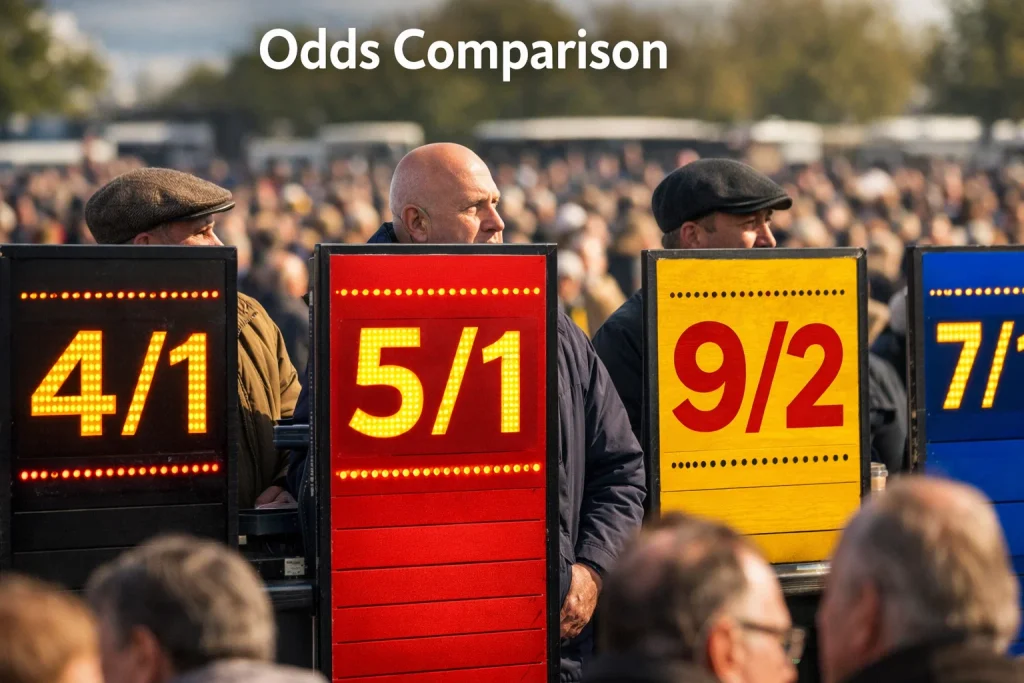
The same horse in the same race can be 5/1 at one bookmaker and 7/1 at another. That gap — two points of odds on a single selection — is your profit margin over time, and odds comparison in horse racing is the process of finding and exploiting it. The racecard gives you the selection; odds comparison gives you the price. Together, they transform a hunch into an informed position and a casual bet into a disciplined one.
Price differences between bookmakers are not bugs in the system — they are features of a competitive market where each operator sets its own margin, responds to its own liabilities and prices its own risk. Those differences exist on every race, every day, and the punter who compares prices consistently extracts more value than the one who accepts the first number offered. The arithmetic is not complicated, but the discipline is rare, and that rarity is what makes price comparison a genuine edge.
This guide covers the mechanics of odds comparison, how to identify value when the price diverges from the racecard data, and the practical tools — including Best Odds Guaranteed and exchange betting — that make price optimisation part of your routine.
How Odds Comparison Works — Bookmakers vs Exchanges
Odds comparison in its simplest form means checking the price of a selection across multiple bookmakers and taking the best one. Most racecard platforms — Racing Post, Sporting Life, Oddschecker, At The Races — display a price grid showing each major bookmaker’s odds in a row beside each runner. The highest number in the row is the best available price. Taking it every time is not a strategy; it is basic financial literacy, and the cumulative effect over hundreds of bets is substantial.
Behind those prices sits the overround — the bookmaker’s margin built into the odds. A perfectly fair book on a two-horse race would price each runner at evens (2.00 in decimal), producing a combined probability of exactly 100 percent. In practice, the bookmaker prices each at, say, 10/11 (1.91), producing a combined probability of 104.7 percent. The 4.7 percent surplus is the bookmaker’s edge — the overround. Different bookmakers apply different overrounds to the same race, which is why prices vary and why comparison matters. A bookmaker running a tight 102 percent overround is giving you better value than one running 108 percent, even if the favourite’s price looks similar.
The market within which this comparison operates is large. Online horse racing betting generated £766.7 million in gross gaming yield in the 2026-2026 financial year. That GGY figure represents the aggregate margin bookmakers retained after paying out winners — the sum of every overround on every race. The punter who reduces the overround they pay, by consistently taking the best price, is effectively clawing back a portion of that margin.
Betting exchanges — principally Betfair and Betdaq — operate on a different model. On an exchange, punters bet against each other rather than against a bookmaker, and the exchange takes a commission (typically 2 to 5 percent) on winning bets rather than building a margin into the price. Exchange odds are often slightly larger than bookmaker odds because the margin structure is leaner. As HBLB Interim Chair Anne Lambert confirmed when reporting on industry trends, betting turnover per race has declined year on year — down 8 percent in 2026-2026 versus the prior year. In a shrinking market, the competition for each bet intensifies, and exchanges offer an alternative pricing structure that can deliver better value on specific selections.
Finding Value — When the Price Is Wrong
Odds comparison tells you which bookmaker offers the best price. Value identification tells you whether that price is worth taking. The two processes are related but distinct, and the racecard is where the second one begins.
A value bet exists when the odds available imply a lower probability of winning than the racecard data suggests is realistic. If your analysis of the form, going, class, draw and connections gives a horse a 25 percent chance of winning, any price above 3/1 (which implies a 25 percent chance) represents value. The challenge is that estimating probabilities is inherently uncertain — but the framework does not require precision, only a reasonable assessment of whether the price is generous or tight relative to the evidence on the card.
The context for value has shifted as the market contracts. Overall betting turnover per race fell 8 percent in 2026-2026 compared to the previous year, and the decline has been steeper when measured against 2022-2023 levels. Tighter markets mean less liquidity, which can produce both opportunity and risk: prices can be more volatile in the final minutes before a race, and the gap between the best and worst available price on a single horse can widen as bookmakers adjust their books more aggressively.
The racecard provides the inputs for value assessment. If the form line, going record, class level and connections all support a horse’s chance, and the odds offered are longer than the market average for a horse with that profile, the price gap means the market has underestimated the selection. Conversely, if the racecard data raises questions — poor going record, stepping up in class, unfavourable draw — and the horse is trading at a short price, the market may have overestimated it, and opposing it (or backing an alternative) becomes the value play.
Value identification is not about being right every time. It is about making bets where the price exceeds the probability over a long series of decisions. The racecard provides the probability inputs; the odds comparison grid provides the price. Reading both together is the core skill of profitable race analysis.
BOG and Price Guarantees — What They Mean for Punters
Best Odds Guaranteed (BOG) is a promotion offered by most major UK bookmakers that eliminates the downside of taking an early price. Under BOG, if you back a horse at a fixed price in the morning and the starting price (SP) is higher, the bookmaker pays you at the SP instead. If the SP is lower, you keep the price you took. In effect, BOG gives you a free call option on the SP — you lock in today’s price with the possibility of an upgrade at no cost.
BOG transforms the dynamics of odds comparison. Without it, taking an early price carries the risk that the horse drifts and you could have obtained a better price later. With BOG, that risk disappears — you can take the best available price at any point during the day, knowing that any upward movement in the market works in your favour automatically. The practical advice is simple: if your bookmaker offers BOG, take the best price you can find as early as you are comfortable with your selection, and let the guarantee cover any subsequent improvement.
Not all BOG promotions are identical. Some bookmakers exclude certain race types (early morning meetings, all-weather fixtures). Some cap the maximum additional payout. Some require a minimum bet size or exclude accumulator bets. The terms are in the small print, and checking them before you rely on the guarantee is worth the 30 seconds it takes.
Rule 4 applies when a horse is withdrawn from a race after you have placed your bet. If the non-runner was a short-priced favourite, its withdrawal changes the probability for the remaining runners, and Rule 4 imposes a deduction on all payouts to account for that change. The deduction scale ranges from 5p in the pound (for a non-runner priced at 10/1 or longer) to 90p in the pound (for a non-runner priced at 1/7 or shorter). Rule 4 deductions are visible on the result card and are applied automatically by bookmakers. They are not negotiable, but awareness of the rule prevents the unpleasant surprise of a reduced payout on a winning bet.
The price gap means everything over time. BOG ensures you capture the upside. Odds comparison ensures you start from the best position. And the racecard ensures you are backing a horse that deserves the bet in the first place. All three work together, and the punter who uses all three consistently operates at an advantage over the one who skips any step.