
What Does P Mean on a Racecard? Every Form Letter Decoded
Best Horse Racing Betting Sites – Bet on Horse Racing in 2026
Loading...
What does P mean on a racecard? It means the horse was pulled up — the jockey stopped riding before the finish line. But P is just one of six letters that mark the races a horse did not complete: P, F, U, R, S and B. Each tells a different story about what went wrong, and each carries different implications for the next time that horse appears on a card.
These non-completion letters are the most anxiety-inducing characters in the form line for casual punters, because they look like failures. Sometimes they are. But experienced form readers know that the context behind each letter determines whether it is a red flag, a yellow warning or, occasionally, no flag at all. This guide decodes every form letter on a UK racecard, explains the separators and the zero, and offers a framework for deciding when a non-completion should change your assessment.
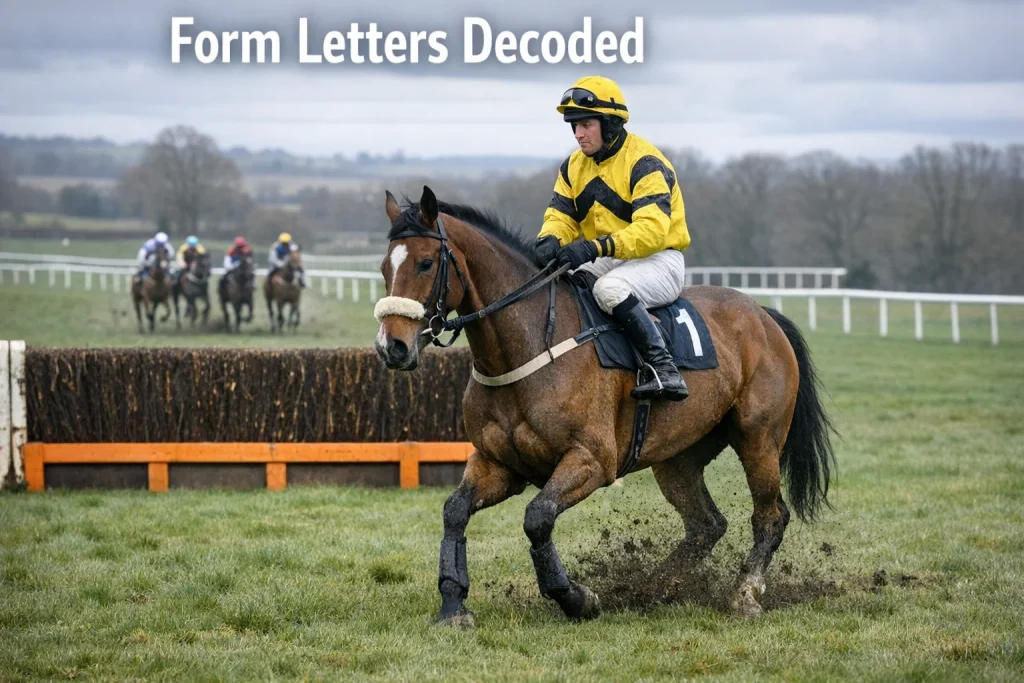
P — Pulled Up
This letter means the jockey pulled the horse up before the finishing line. The decision to pull up can be made by the jockey, instructed by the trainer via pre-race instructions, or directed by a racecourse veterinary officer if the horse shows signs of distress or injury during the race.
In National Hunt racing, P appears frequently — far more often than on the Flat — because the risks of continuing over obstacles when a horse is tired, injured or hopelessly out of contention are higher. Pulling up is, in many cases, a safety measure. The BHA recorded a fatality rate of 0.18 percent in 2023 (158 fatalities from 87,619 starts), down from 0.20 percent the previous year, and part of that improvement reflects a culture where jockeys are encouraged to pull up rather than push tired horses through the final fences.
When a P appears in the form line, the first question is why. If the horse was pulled up because it was exhausted after leading for two miles and fading — that is a stamina concern. If it was pulled up because it made a jumping error and the jockey decided not to risk another obstacle — that is a caution flag on jumping ability. If it was pulled up after being hampered by a faller and losing all chance — that is a circumstantial non-completion that tells you nothing negative about the horse itself. The race comments, available on detailed racecard platforms, usually explain the reason, and reading them turns a bare P into useful information.
F, U, R, S, B — The Other Non-Completions
F — Fell. This letter means the horse fell during the race, almost always at an obstacle. A fall can be caused by the horse’s own jumping error, by interference from another runner, or by the ground conditions affecting its footing on landing. A single F in an otherwise clean jumping record is less concerning than multiple Fs, which suggest a systemic jumping weakness. On the racecard, the distinction between a horse that fell at the first fence (never tested in the race) and one that fell at the last when leading (was running well but made a crucial error) is invisible in the form figure but visible in the race commentary.
U — Unseated Rider. This letter means the jockey was dislodged from the horse, but the horse itself did not fall. The distinction matters: an unseated rider often results from a bad jump where the horse pecked on landing and the jockey could not maintain the riding position, or from the horse ducking sharply to one side. The horse remains on its feet, which is a different outcome from a fall. A U in the form line is generally considered less serious than an F, because the horse’s jumping mechanism was not fundamentally at fault — the error was in the rider-horse coordination at a specific moment.
R — Refused. This letter means the horse refused to jump an obstacle — it planted its feet and would not take off. Refusing is a behavioural issue, and it is one of the most concerning non-completion letters on the racecard. A horse that refuses once may do it again, because the behaviour often stems from a loss of confidence, fear, pain or unwillingness. Multiple Rs in a form line is a serious warning sign, particularly in National Hunt racing where every fence demands a willingness to jump. On the Flat, refusals are extremely rare and almost always occur at the starting stalls rather than during the race.
S — Slipped Up. This letter means the horse lost its footing and went down without an obstacle being involved. Slipping up is uncommon and typically occurs on waterlogged ground, on tight bends, or on all-weather surfaces in extreme conditions. An S in the form line is almost always circumstantial — it reflects the ground conditions on the day rather than any inherent weakness in the horse. Unless you see multiple Ss, this letter should not influence your assessment of the horse’s future ability.
B — Brought Down. This letter means the horse was brought down by another horse’s fall — it was an innocent victim of interference rather than the cause of the incident. A B is the least concerning of all non-completion letters because it tells you nothing about the horse’s own ability, jumping technique or willingness. If anything, a B followed by a return to form on the next run confirms that the horse was unaffected by the experience. The racecard records the B for completeness, but informed readers treat it as a void result rather than a negative one.
0 vs Dash vs Slash — Separators and Zero Explained
Three more characters appear in form lines alongside the numbers and letters, and each has a distinct meaning that affects how you read the sequence.
0 means the horse finished tenth or worse. It does not mean the horse did not finish — it completed the race but was beaten a long way. A 0 in the form line is a poor result, but it is a completion, which distinguishes it from P, F or U. A horse with a form line of 0-0-0 has been comprehensively beaten in three consecutive races, and the market reflects this: horses with a string of recent zeros are rarely among the favourites. Given that favourites win approximately 30 to 35 percent of UK races, a horse buried in zeros is swimming against the statistical tide.
– (dash) separates individual runs within the same season. The dash is a formatting convention, not a result. A form line reading 1-3-2 means: won, then third, then second, all in the current season. On some platforms, dashes are omitted and the figures run together (132), but the meaning is identical.
/ (forward slash) separates the current season from the previous one. A form line reading 2-1/4-3 means: this season, second then first; last season, fourth then third. The slash is important because form from a previous season is less current — the horse may have improved or deteriorated during the break, and the conditions (going, fitness, competition) may differ. As a general rule, form on the right side of the slash (the current season) carries more weight than form on the left.
How Non-Completions Affect Your Card Reading
The practical question when you see a non-completion letter in a form line is: should this change my assessment of the horse’s chance today?
The answer depends on three factors: the letter itself, the frequency, and the context. A single B (brought down) in an otherwise strong form line should change nothing — the horse was an innocent bystander. A single P after a string of good results may indicate a bad day, a minor injury, or a tactical decision by the trainer to preserve the horse for a future engagement. A single F in a jumps form line is concerning but not disqualifying, particularly if the horse has a long record of clean jumping either side of the fall.
Frequency is the critical multiplier. One P is a data point. Three Ps in five runs is a pattern, and the pattern suggests a horse that either lacks stamina, has a recurring injury, or is being campaigned beyond its current ability. Multiple Fs in a jumping horse’s record signal a genuine weakness over fences that is unlikely to resolve itself. Multiple Rs are the most damning — a horse that has refused more than once has a behavioural issue that may be permanent.
Context comes from the race commentary and the conditions. A horse that was pulled up on Heavy ground may run perfectly well on Good. A horse that fell at Aintree’s Grand National fences may jump cleanly over regulation fences at Sandown. The letter records the event; the commentary explains it; and the conditions of today’s race determine whether the explanation is relevant. Reading non-completions on the card is not about counting letters — it is about understanding causes, and the racecard provides the data to do exactly that.