
Racecard Printouts and PDF Form Guides: Offline Racing Cards
Best Horse Racing Betting Sites – Bet on Horse Racing in 2026
Loading...
Despite the shift to mobile, a printed racecard remains part of the raceday ritual for millions. Nearly 4.8 million people visited British racecourses in 2026, and a substantial proportion of those racegoers — particularly those who attend regularly — want a physical card to annotate, share and keep. Racecard printouts and PDF form guides serve a purpose that a phone screen cannot replicate: they offer a surface you can write on, a layout you can see in full without scrolling, and a document you can fold, pass to a friend and carry in your pocket without worrying about battery life.
The market for printable racecards sits between the digital card and the on-course programme. Digital cards are free, live and updated in real time, but they are ephemeral — close the app and the card is gone. Racecourse programmes are beautifully produced but cost money and are only available at the venue. Racecard printouts occupy the middle ground: they can be downloaded, printed and taken to the course or used at home as a working document that you mark up as the day develops.
This guide covers where to find printable racecards, how they differ from their digital counterparts, and how to use a printed card effectively as an analytical tool.
Where to Get Printable Racecards — Sources and Formats
Several platforms offer racecard printouts in formats designed for A4 or US Letter paper. The quality and depth of data vary by source, and the choice depends on how much information you want on the printed page.
Racing Post offers a print-friendly racecard layout that includes form lines, official ratings, RPR, topspeed figures and a comment for each runner. The Racing Post printout is the most data-dense option available, and it is the format that most experienced racegoers use when they want a paper card. Full access requires a subscription, but the printable format is well optimised for paper — the columns are readable, the font sizes are appropriate, and each race fits neatly onto a single page or section of a page.
Sky Sports Racing (formerly At The Races) provides free printable racecards through its website. The layout is cleaner and less dense than Racing Post’s, with form, going, odds and basic runner information presented in a format that works well on paper without feeling overwhelmed. For racegoers who want a printed card without the cost of a subscription, Sky Sports Racing’s printout covers the essential data points.
Sporting Life offers free printable cards with tips and verdicts included alongside the data. The Sporting Life printout is particularly useful for punters who want an editorial opinion alongside the raw numbers — the tips are printed beside each race, giving you a starting point for analysis before you apply your own filters.
Racecourse programmes are the traditional paper racecard, sold at the venue on race day. They typically cost between £2 and £5 and include the racecard for every race at that meeting, along with editorial content, course information and advertising. Programmes are produced before the day’s racing begins, which means they may not include late non-runners or going changes that occurred after printing. Despite this limitation, programmes remain popular because they are a physical artefact of the day — a keepsake as well as a working document.
PDF form guides are offered by specialist providers and some tipster services, typically as a downloadable document that covers every race at a meeting with extended form analysis. These guides go beyond the standard racecard to include pace maps, speed figures and detailed race previews. They are the most comprehensive printed option but are rarely free, and their value depends on the quality of the analysis.
Online vs Printed Cards — What’s Different
The underlying data is the same — runners, form, odds, going, draw — but the presentation and usability differ in ways that affect how you work with the card.
Information density is the most obvious difference. A digital racecard can display limitless data through scrolling, expanding sections and linked profiles. A printed card must fit its information onto a fixed page, which means choices have been made about what to include and what to leave out. Most printable racecards show the last six runs in the form line, the current odds from two or three bookmakers, the going description, the draw and the official rating. Extended data — full career form, going breakdowns, trainer and jockey statistics — is typically available only on the digital version.
Live updates are the digital card’s decisive advantage. Non-runners, going changes, odds movements and jockey swaps are reflected on digital cards within minutes. A printed card is frozen at the moment it was generated. If you print the card at 8:00am and a non-runner is declared at 10:00am, your printed card still shows that horse in the field. For this reason, the printed card gives you a working base, but it needs to be cross-referenced with a quick digital check before each race to catch any changes.
Saturday meetings, which drew an average attendance of 6,480 per fixture in 2026 — the highest of any day — generate the greatest demand for both digital and printed cards. The printed card gives you a tactile document to work with in the parade ring or the grandstand, where pulling out a phone is sometimes impractical; the digital card gives you the updates that keep the printed version current. The most effective approach uses both.
Making the Most of a Printed Card — Annotation Tips
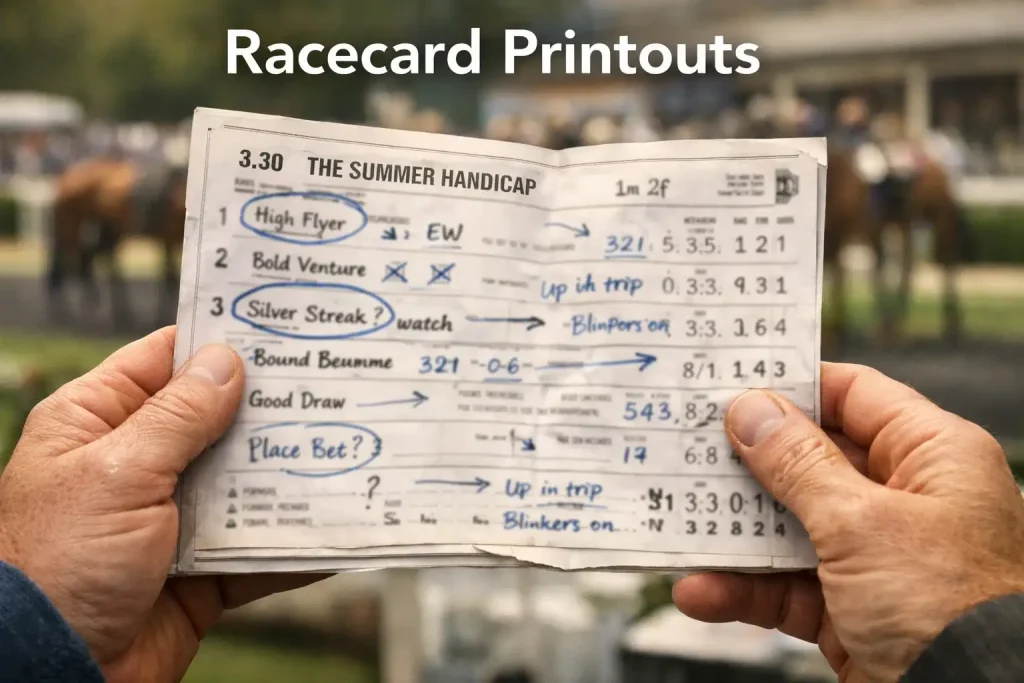
The real advantage of a printed card over a digital one is that you can write on it. A phone screen does not accept pencil marks, circles, arrows or shorthand notes. A printed card does, and the punters who annotate their cards systematically extract more value from the document than those who read it passively.
The simplest annotation system uses three marks. A tick beside a horse’s name means it passes your initial form filter — recent form is positive, going is suitable, class is appropriate. A cross means it fails on one or more criteria and can be eliminated. A question mark means the horse is interesting but requires further investigation — perhaps the going record is unproven, or the class step is uncertain. After marking every horse in a race, you are left with the ticks and the question marks, and the printed card gives you a visual shortlist at a glance.
Add notes in the margins. Write the forecast going beside the race header so you can compare it to the actual going when it is announced. Circle the draw number for any horse at a course with known draw bias. Underline a jockey’s name if it is a notable booking. Note the headgear code if a horse is wearing first-time blinkers or a tongue tie. These marginal notes transform the printed card from a passive data sheet into an active analytical document — a tool that records your thinking as the day develops.
After each race, record the result on the card. Write the winner’s name, the SP and the official going beside the race header. Over a day’s racing, the annotated card becomes a personal form record — a document that captures not just what happened but how you read the card before it happened. Reviewing annotated cards from previous racedays is one of the most effective ways to improve your form reading, because you can see where your assessment was right, where it was wrong, and why.
The printed card gives you a surface for thinking. The annotations turn that surface into a record. And the record, accumulated over weeks and months of racedays, builds the pattern recognition that makes every future card — printed or digital — more readable.