
Racecard Abbreviations: Complete List of UK Racing Card Symbols
Best Horse Racing Betting Sites – Bet on Horse Racing in 2026
Loading...
A UK racecard abbreviations list is, in practical terms, the Rosetta Stone of British horse racing. Every column on the card is compressed into shorthand — letters, numbers and symbols that experienced racegoers parse in seconds and newcomers find utterly baffling. The gap between those two groups is smaller than it looks, because the full set of abbreviations is finite and, once learned, applies uniformly across all 59 racecourses in Britain.
What makes abbreviations worth studying, rather than just Googling one at a time, is how they interact. A form line reading 1-3-P next to an equipment flag b1 tells a different story than the same figures without the headgear change. The letters and symbols on a racecard are condensed intelligence, and each one earns its column space.
This reference covers every abbreviation you are likely to encounter on a modern UK racing card, grouped into three categories: form symbols that describe what a horse has done, runner indicators that flag key attributes, and headgear codes that record equipment changes. If a symbol appears on a card published by Racing Post, Sky Sports Racing, Sporting Life or any licensed operator, it is listed here.
Form Abbreviations: Numbers, Letters and Symbols
The form line is the sequence of characters that appears beside every runner’s name, usually reading right to left from the most recent run. Each character stands for a single performance. Numbers are straightforward: 1 means the horse won, 2 means it finished second, and so on up to 9. A finish outside the first nine is recorded as 0 — not zero in the mathematical sense, but shorthand for “tenth or worse.”
The letters carry more weight than the numbers in many cases, because they describe how a run ended rather than where.
P stands for “pulled up.” The jockey stopped the horse before the finish, usually because it was exhausted, injured or hopelessly out of contention. In National Hunt racing, P appears frequently and does not always signal disaster — some trainers pull up horses as a precaution rather than risk a fall. F means the horse fell, most commonly at a fence or hurdle. U means “unseated rider,” where the jockey parted company with the horse but the horse itself did not fall. The distinction between F and U matters for assessment: a horse that unseats its rider may have made a jumping error, while a faller may have been brought down by another horse entirely.
R stands for “refused,” typically at a fence. A horse that plants its feet and will not jump is given this letter, and it raises serious questions about willingness for future engagements over obstacles. S means “slipped up,” which is rare on turf but does occur on all-weather surfaces or heavily watered ground. B indicates the horse was “brought down” — felled by another horse’s fall rather than its own error. This distinction matters enormously because a B result tells you nothing about the horse’s own jumping ability.
Two separator symbols divide the form line into seasons. A / (forward slash) separates the current season from the previous one. A – (dash) separates individual runs within the same season. So a form line of 21-3/14-0P reads: this season the horse won then finished second, followed by a third; last season it won, then finished fourth, then ran outside the top nine and was pulled up.
Races on the Flat and over jumps are sometimes mixed within a form line. Some publishers mark National Hunt form in a different typeface or add a suffix, but the standard abbreviations remain identical across both codes. Reading the form line accurately means treating each character as a chapter in a running story — the order, the gaps, and the letters between the numbers all contribute to the picture.
Runner Indicators: Flags That Follow the Horse’s Name
Beyond the form line, UK racecards attach several indicator flags to each runner. These are the letters and numbers that appear in dedicated columns or beside the horse’s name, and they compress a surprising amount of analytical value into single characters.
C stands for “course winner” — the horse has won at this specific racecourse before. This flag matters more than casual observers realise, because some courses have unique layouts (Chester’s tight left-hand bend, Epsom’s camber, Beverley’s stiff uphill finish) that suit particular running styles. A horse carrying a C has proven it can handle the track’s idiosyncrasies.
D means “distance winner.” The horse has won at today’s race distance. Like course form, distance form is one of the most reliable predictors in race analysis. CD combines both — a horse that has won at this course and this distance — and is considered an especially positive indicator. BF stands for “beaten favourite,” flagging that the horse was sent off as market leader in a previous race and lost. The beaten favourite indicator cuts both ways. On one hand, it shows the market thought this horse was good enough to be favourite; on the other, it failed to deliver. Across British racing, favourites win roughly 30 to 35 percent of all races, which means the BF flag is attached to a lot of horses. How you interpret it depends on the reason for the defeat — was it the going, the trip, the draw, or genuine inability?
OR is the official rating assigned by the BHA handicapper. This number determines how much weight a horse carries in handicap races and serves as the sport’s official measure of ability. An OR of 100 puts a horse in competitive handicap territory; above 110, and it is nearing Listed-race class. The OR column on the racecard is particularly useful for identifying horses that may be “well handicapped” — running off a rating that underestimates their current ability.
TS stands for “topspeed rating,” a performance figure calculated by the Racing Post based on finishing speed. RPR is the Racing Post Rating, a broader assessment of overall performance. Both numbers appear alongside the OR on most major racecard platforms and give punters an independent check against the handicapper’s assessment. When the RPR is significantly higher than the OR, the horse may be ahead of its official mark — a signal that value could be available in the betting market.
Headgear and Equipment Codes
Headgear codes sit in their own column on most racecards, and they record what equipment a horse is wearing on race day. These are not cosmetic details. Equipment changes are among the most actionable signals on a racecard, because they indicate a trainer is trying something new to alter a horse’s behaviour or concentration.
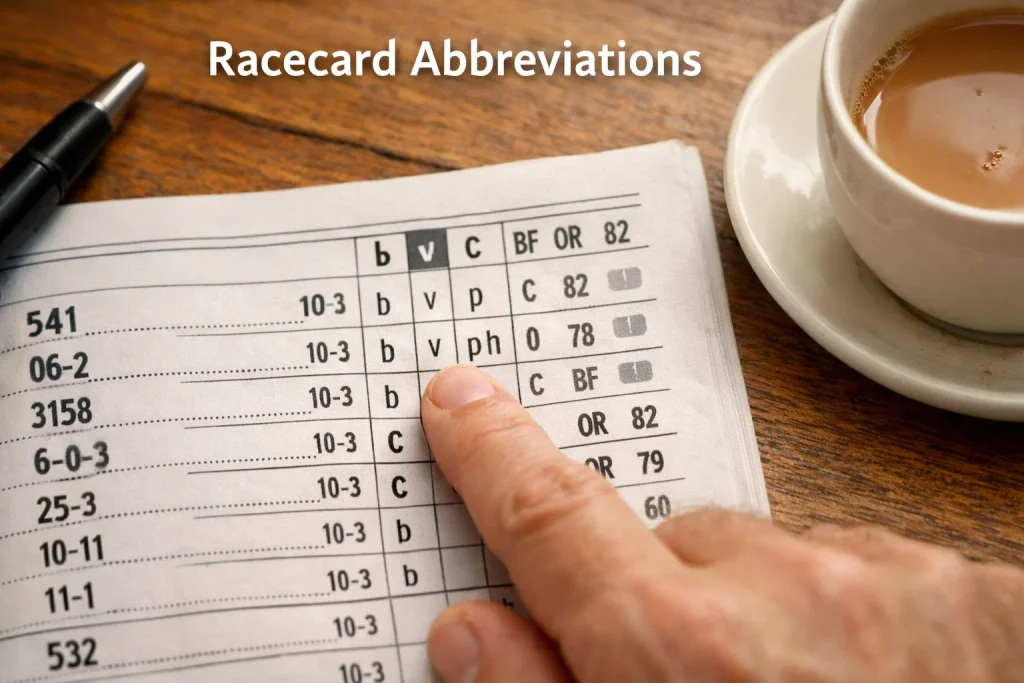
b stands for blinkers — eye cups that block a horse’s rear and peripheral vision, forcing it to focus forward. Blinkers are the most commonly applied piece of headgear and are used to sharpen the attention of horses that tend to idle, hang or lose interest mid-race. v denotes a visor, which is a modified blinker with a slit cut into one side, allowing partial peripheral vision. Visors are considered a softer intervention than full blinkers. p stands for cheekpieces — strips of sheepskin attached to the cheekstraps of the bridle that limit backward vision without the full restriction of blinkers. h means a hood, covering the ears and sometimes the eyes, primarily used in the pre-parade ring and removed before the start. Some horses wear hoods to the start and race in them; others wear them only in the paddock to keep calm.
t stands for a tongue tie — a strap or band that secures the horse’s tongue to its lower jaw, preventing it from retracting over the palate and obstructing the airway. Tongue ties are functional equipment rather than behavioural, and their application has increased significantly in recent years as trainers seek non-invasive solutions to breathing issues.
The most important modifier in the headgear column is the number 1 appended to any letter. b1 means first-time blinkers; v1 means first-time visor; and so on. First-time headgear is statistically significant. Studies across thousands of UK races consistently show that horses wearing blinkers for the first time perform above their expected level at a higher rate than the general population. The effect tends to diminish with repeated application, which is why the “1” suffix is such a valuable flag — it tells you the trainer is making a deliberate intervention that the market may not have fully priced in.
Equipment codes are standardised across every British racecourse, so whether you are reading a card for a Class 7 handicap at Wolverhampton or a Group 1 at Ascot, the letters mean the same thing. That consistency is one of the quiet strengths of the UK racecard system — learn the codes once, and they work everywhere the sport runs.